New technology in manufacturing process is profoundly changing industrial production, giving rise to “the factory of the future.” Augmented reality, 3D Printing, Robotics, Wearables and the widespread applications of Blockchain technology are digitally transforming factories and manufacturing plants. It has ushered a new era of growth, with the industry projected to expand 7x faster than its best record in the 1990s.
The so-called Fourth Industrial Revolution is here and the confluence of technology is making a remarkable and bold impact on how factories operate.
A New Age for Production
A growing number of factories which operate on a massive scale now follow “lights-out manufacturing.” This does not only refer to the absence of light in the facility, but more specifically, the absence of human workers. The manufacturing plants operate autonomously— and without lighting and heat— because their “workers” are machines with robot-run settings.
Japanese robotics manufacturer FANUC has been using an autonomous factory since 2001. The factory produces robots in a continuous assembly line without any humans on the floor. The operations have turned off their lights in the factory since the robot production does not need any eyes to see.
Changying Precision Technology Company, a phone part maker based in Dongguan City, China runs an unmanned factory. The processes are operated by computer-controlled robots. The human staff monitors the activity and progress of all the machines via a central control system. The use of robotic arms in production trimmed down their personnel from 650 workers to just 60. Further automation is projected to pare that number further to only 20.
Where it Starts: Research and Development
Technology is re-shaping various manufacturing and production processes, beginning with research and development.
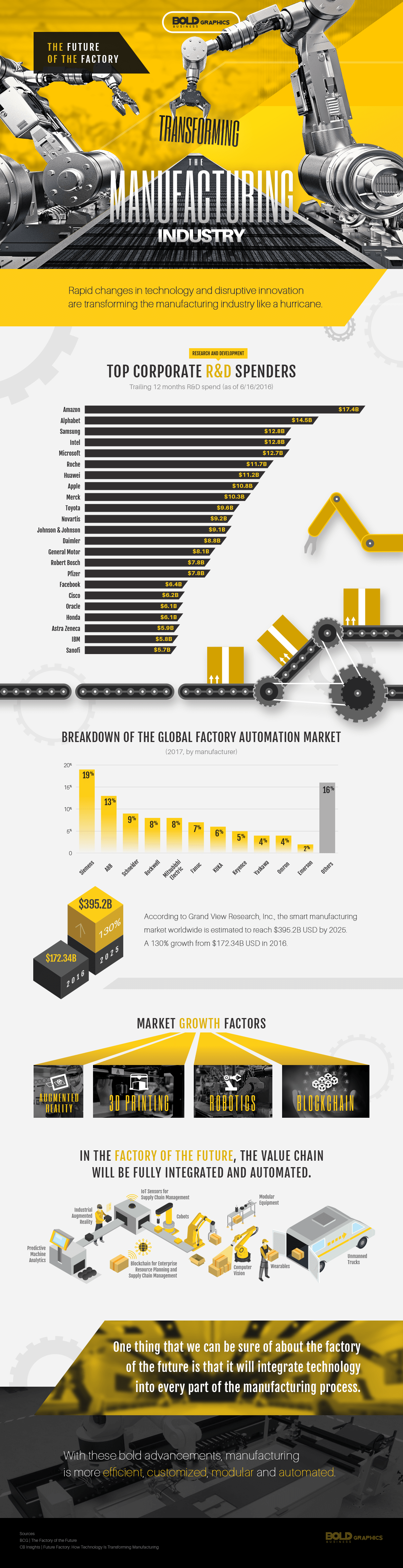
All over the world, billions of dollars are poured into Research and Development across various industries. Detroit, MI based vehicle manufacturer General Motors spent $8 billion on new developments in 2017 alone. To keep up with the competition, companies use 3D printing, artificial intelligence and robotics to boost their R&D efforts. This does not only make the testing phase faster, but it also reduces the margin of error when a product goes into production.
According to CB Insights, 57% of companies now use 3D printing in the initial phase of new product development to accelerate the process. 3D printing is an excellent and cost-effective tool for prototyping and proof of concept.
At the same time, robotic arms are also saving companies millions when it comes to the testing phase. The robots are used for countless “trial and error” experiments, making the process not only safer for workers, but also faster in terms of assessing possible outcomes.
Some examples are liquid handling robots, gene-testing robots, as well as robots which handle nanoscale technologies. The last type is being used by chip manufacturers like Intel and Samsung for their intricate systems.
Helping Workers Become More Efficient
Improved digitization and additional cyber-physical technologies are augmenting the efficiency of human workers.
The use of Augmented Reality and Virtual Reality as tools for design and manufacturing will allow real world customization of products. Prototyping will also greatly benefit from these technologies. AR and VR offer workers an improved way of seeing a product in 3D. It has also effectively digitized the instruction manual and has led to fewer design errors and revisions.
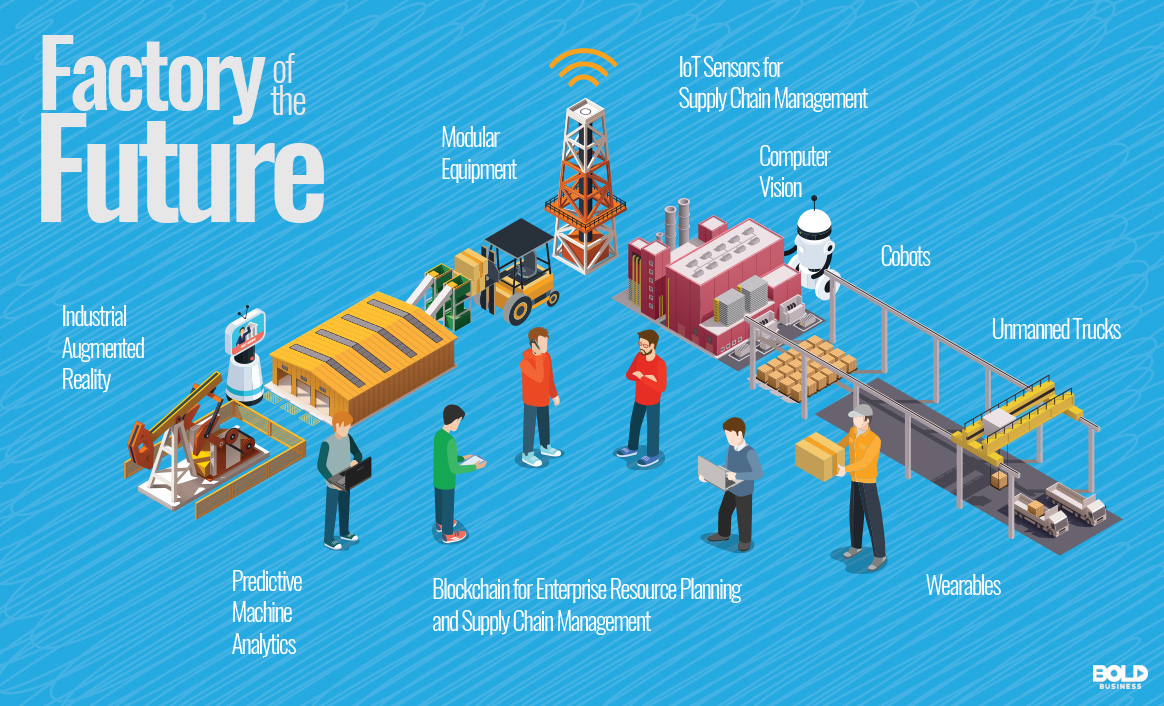
Through this tech, workers are able to analyze complicated machines and map them out visually to help them work more accurately.
Products currently being used include headsets made for industrial settings by Daqri and Atheer. At the same time, Upskill created the Skylight platform which uses Google, Glass, ODD, Vuzix and Relwear headsets to apply AR in an industrial workforce.
Other companies use scanning and tagging technologies. Parsable, formerly called Wearable Intelligence, the company employs mobile collaboration and a workflow platform for industrial teams. Instead of paper and pencil, Parsable uses mobile devices to give workflow tasks and assist in data collection.
Additional tools that help workers perform their tasks better are exoskeletons and wearables. It protects workers and prevents injuries brought about by repetitive movement. These tech are now seen on factory floors, including load-bearing gear that support a worker’s limbs and back.
The Ekso Vest from Ekso Bionics is already being used by workers at Ford Motor Company’s assembly plant in Michigan. Besides reducing neck strain and injuries, the revolutionary gear offers the wearer lift assistance without using batteries. Once the plant’s workers are already used to the idea of “suiting up”, they are planning to move to powered exosuits.
Remote-controlled robotic arms have also been delegated to handle the heavy lifting in most factories.
QA and Real Time Checking
Digital factories use data platforms which run on machine-learning such as Fero, Sight Machine, and Uptake to maintain Quality Assurance (QA). QA cannot be overemphasized. Done correctly, it can help lower manufacturing costs by understanding why a product failed, and correcting it in the next product iteration, during production.
It helps ensure that product defects are kept at a minimum. Computer vision and blockchain for supply chain are some tools which are now being used with QA. Blockchain ensures accountability, with secure fraud-free data.
Food products are vulnerable to spoilage and may require constant quality assurance during the transit from farm to the end user or consumer. When a food product goes bad during the delivery, the blockchain ledger can be used to track back where the product came from, and when. It is also possible to track where the supplier sent the same product. This can lessen the damage that can happen by preventing spoiled goods from reaching the market. Or, it can be used to track other produce from the same batch which might also have spoiled at some point in the supply chain.
Last year, the country’s biggest food manufacturers and distributers, including Nestle, Unilever, Kroger, and Walmart, used IBM’s supply chain tracking to improve their supply tracking systems. IBM uses blockchain tech to reduce tracking time. Walmart has been using it since 2016 and said that shipments which used to take 7 days to track can now be located in as fast as 2.2 seconds.
Managing the Transport and Supply Chain
There are a lot of technology in use in transport management and supply chain. These include telematics, Internet-of-Things (IoT), robots and autonomous vehicles. Adding blockchain to the supply chain also ensures that the information cannot be falsified.
Blockchain ledgers have a unique verification system. Each record has a copy of the hash number of all transactions preceding it. Adding more records to the ledger strengthens the security of earlier transactions. To change the entries for an earlier record, the user has to change every the hash value in every other record after the revised transaction. This is a self-securing process as long as new transactions keep coming. Falsifying blockchain ledger entries is hard and is even harder if it was older data was falsified.
Blockchains operate on the cloud. Servers around the world are used in a cooperative manner to compute the current hash value. Each of these servers also have a copy of the ledger. To falsify information, each of these servers copy of the ledger has to be revised all at the same time.
Another feature of blockchain ledgers is that there should be a consensus among the servers on the cloud which keep the record. Consensus is achieved when all the servers agree on the hash value of the current transaction. If the servers do not agree on a particular ledger entry, that copy of the blockchain is no longer used.
Using blockchain ledgers to keep track of the supply chain ensures that the information is always correct based on the consensus of the servers calculating the blockchain’s next transaction.
Robots in the Warehouse
Robots have created extremely efficient and almost “human-free” warehouses. With Amazon’s volume of product traffic, there is no way to ensure prompt sorting, cataloguing, and request servicing without robots getting the correct products from the shelf. Other factory warehouses, including e-commerce giant Alibaba, are also doing the same thing. One benefit of a warehouse run by robots is that these can operate even without air conditioning, heating or lighting.
Traditionally, robots have been used in jobs which are dangerous, require heavy lifting and are repetitive. The older generation of robots were programmed with step-by-step processes in order to do the job. This is a detailed process which requires a long iterative process of coding and testing, until the robot is allowed on the shop floor.
Today’s robots are trained in a collaborative process where they work beside human workers and they emulate the movements for a particular process. Called “cobots”, they are programmable robotic arms that copy their first movements. This is very much like the training that a human operator would undergo.
Today’s digital tools are in use almost as soon as they are developed for mainstream applications. These technologies help manufacturing plants and companies cope and overcome obstacles with bold ideas and novel approaches. There’s no question that things will only become more interesting from here.