With 30% of fatal road accidents caused by drivers who have fallen asleep by the wheel, researchers from the University of Liège in Belgium have developed a technology that can monitor and predicts a driver’s eye behavior in order to anticipate drowsiness. This is a bold and ground-breaking development of the anti sleep device for drivers will be key in preventing transportation accidents – eventually saving thousands of lives in years to come.
The University’s Department of Electrical Engineering and Computer Science, under Prof. Jacques Verly, worked on the project for 10 years, Phys Org reports. Together with its spin-off company, Phasya, the team has been recognized for their innovative and validated solutions in the field of somnolence or drowsiness monitoring. The study encompasses all types of vehicles, including boats, trains, and helicopters or airplanes.
“our technology for monitoring drowsiness/somnolence, in particular with the addition of prediction in the future, is the most advanced in the world today”
The technology is “based on the analysis of images of the eye taken by a camera at the highest possible speed (in the range of 30 to 120 images per second and higher), and on the fact that the scientific literature has established that the behavior of the eye is one of the best indicators for drowsiness. The eye is indeed directly connected to the brain, where the wake/sleep cycle is governed,” the article read.
Aside from head-mounted solutions, the team has also developed remote systems with a camera mounted on the vehicle’s dashboard or the plane’s instrument panel. This unique “drowsimetry” tech was validated through a series of polysomnography tests, driving performances as well as psychomotor vigilance tests.
The team’s work will have a bold and profound impact not only on the transportation industry, but also in safety and accident prevention. Current technology relies solely on cameras monitoring “white” lines or analyzing the movements of the steering wheel – which is not specific to drowsiness or sleepy drivers at all and does not apply to scenarios where the driver’s hands aren’t on the wheel such as in the case of autonomous or driverless vehicles.
The team’s findings can in fact be applied to autonomous cars and be a good way to determine when it is time to take control of the vehicle from the driver. While far from being perfect, the research can be continued and refined to better work with other technologies.
“To the best of our knowledge, our technology for monitoring drowsiness/somnolence, in particular with the addition of prediction in the future, is the most advanced in the world today”, says Prof. Jacques Verly.
Immediate Solutions
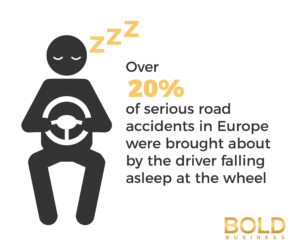 Sleep Neuroscientist Prof. Jim Horne reported that over 20% of serious road accidents in Europe were brought about by the driver falling asleep at the wheel. These accidents happen more often between 2 and 6 am when the human body is supposed to be asleep. The accidents reportedly cut across different age groups, meaning all motorists are susceptible to falling asleep at the wheel due to monotonous driving conditions.
Interestingly, it only takes moments for a driver to lose control of the wheel. Motorists can fall into “microsleep” in as fast as 20 minutes and can last for about 5 to 7 seconds. The likelihood of falling asleep on the wheel is compounded for people who work night shifts or shifting schedules since the body is forced to adjust abruptly to the change of schedules.
The University of Liège’s research is expected to have as bold an impact on the safety industry as the introduction of the seatbelt. Their physiology-based technology can drastically improve vehicle safety, especially for people who drive for long stretches. However, it may be a while before this technology can be applied on the road.
In the meantime, other measures are being adapted to help sleepy drivers, and prevent further accidents from happening. In the UK, signage has been erected on highways encouraging motorists to pull over and rest instead of driving while too tired.
While technology can determine eye movement and predict drowsiness, humans should not forget to listen to their own bodies.


 Google’s criteria for choosing which organizations will receive donations include the possible effect of technology and tech education as part of a meaningful solution without it being forced in the current environment. Another consideration is that there should be an impact in the near and medium term,