Bold Business Logo

Amazon’s Long-Term Investments Creates Moats around Their Businesses

Amazon, one of the top tech movers of the past two decades, recently opened their concept Amazon Go store in Seattle, Washington. Dubbed as a grocery story of the future, this partially automated futuristic concept store allows customers to buy several products with no need for a cashier or checkout counter. A person simply takes an item off the shelf and it is automatically added to their virtual shopping cart, so they can come and go anytime they want – a bold idea that is bound to shake up the industry.

While this store officially opened to the public only in January, it was actually already open to Amazon employees since 2016. This two-year time period let the e-commerce titan test several technologies such as sensor fusion, computer vision, and deep learning algorithms before the prototype location was unlocked to the rest of Seattle.


Their “Just Walk Out Shopping” experience is just one of Amazon’s countless businesses that allowed the tech giant to build massive moats around their innovations, allowing them to not only execute revolutionary products and services, but also lead in whatever industry they try to penetrate.

Leading for the Long Term

Established in 1994 as Cadabra by Jeff Bezos, Amazon went public in 1997 originally as an online bookstore that later diversified into several industries and services. Just how did Bezos create a company that boomed into a global household name with over half a million employees in just two decades?

Amazon surpassed Microsoft in market value at $702 billion on February 14, 2018, claiming the third spot, behind only Google and Apple, among the largest US companies. The Seattle-based group’s surge bolsters its position as a global tech giant, as it continues to expand its operations to include artificial intelligence, cloud computing, package delivery, consumer devices, entertainment and other businesses.

In several interviews, Bezos has mentioned that he tends to invest in things with the long-term result in mind. He plants proverbial seeds that may take years to bear fruit, a risky move that not many entrepreneurs are willing to undergo. Most companies take a conventional two or three-year approach, but Bezos is okay with allowing something to bloom for longer than that.

“If you’re long term oriented, customer interests and shareholder interests are aligned,” he explained. “In the short term, that’s not always correct… Some of the things that we have undertaken I think could not be done in two to three years… Basically if we need to see meaningful financial results, …some of the most meaningful things we’ve done we would never have even started.”

He cited many of his successful investments, such as the popular ebook reader Kindle, Amazon Prime, and Amazon Web Services, among many others, as just some of those. He also revealed that he takes other types of unconventional moves.

“Our approach to our hardware Kindle devices, Kindle Fire and our Kindle readers, is to sell the hardware at near breakeven, and then we have an ongoing relationship with the customer where they buy content from us– digital books, music, movies, TV shows, games, apps,” he revealed. “The reason that we like that approach is because we don’t make $100 every time we sell a Kindle Fire HD, since it’s near breakeven. Instead of making a bunch of money, then, we’re happy if people keep using our products. We don’t have to have you on the upgrade treadmill.”

Misunderstood but Effective

Bezos has always used unusual approaches to his bold businesses. In fact, even during the start of his Amazon career, a customer wrote to him saying he does not understand his own business. “You make money when you sell things. Why do you allow these negative customer reviews?” the letter read. When Bezos got that feedback, he thought it was not true of Amazon. “We don’t make money when we sell things – we make money when we help customers make purchase decisions,” he said.

He refers to his often misunderstood approach as an “explorer mentality,” as opposed to a “conqueror mentality” prevalent in many businesses today. They also focus on customer experience, which they refer to within the company as “True Customer Obsession,” an engagement strategy that allows them to consistently outperform many other retailers.

Amazon is very much open to spending a lot, albeit wisely. Ben Thompson, owner of well-known tech blog Stratechery, analyzes that Amazon’s willingness to spend is what truly differentiates them. Compared to most other tech companies, Amazon’s core is not just on software. He assessed that while spending, in the short-term, seems risky and painful – the exact reason most other software companies avoid that approach; however, it lets Amazon create such massive moats around their businesses, receiving the greatest possible returns on their bold investments.

Moat Mentality

Amazon’s customer focus and emphasis on long-term perspectives has permitted them to become the authority in whatever bold business they come up with. They have a moat mentality that pretty much separates them from the tech herd, either through smart investments or daring acquisitions.

Such an example is their 2012 purchase of Kiva Systems, costing them a record $775 million – their largest acquisition to date. Kiva built robots for Amazon Fulfillment, which baffled analysts because Kiva already had a proper customer base to begin with. In fact, many say Amazon could have just bought Kiva’s robots instead for a whole lot less. So why did they pay for 8 times Kiva’s revenue? Simple. Amazon was not interested in sharing what Kiva had to offer to their competitors – they took up everything, creating a huge gap in the market. What many would say is a “wrong” move when viewed in the short-term perspective, was actually a brilliantly bold effort in the long run. They initially spent millions of dollars at first, but were able to create and improve their fulfillment centers better than any of their competitors.

Thompson wrote in his tech blog that Amazon is not likely to license out the tech Amazon Go uses either. “Make no mistake, that is exactly what a company like Google would do (and as I expect them to do with Waymo), and for good reason: the best way to get the greatest possible return on software R&D is to spread it as far and wide as possible, which means licensing. The best way to build a moat, though, is to actually put in the effort to dig it, i.e. spend the money,” he explained. As such, he believes the company took big, painful risks but have proved them effective.

Another notable moat they have created is that of the voice-controlled artificial intelligence (AI) personal assistant service. Their Amazon Echo smart speakers, in tandem with the AI assistant named Alexa, is the first virtual assistant that is years beyond its competitors. Today, devices like Google Home and Apple HomePod exist, but Amazon’s reputed Echo and Alexa are still ahead of the game. Even fellow tech giant Microsoft is trying to get in with their Cortana AI assistant software, made for other gadgets rather than for an exclusive Microsoft product. Interestingly, it is compatible with Alexa for a future release, thus further establishing Amazon’s competitive advantage.

Applying bold ideas and new technologies lets Amazon gain and maintain their edge. Their customer-centric style is a business model that many other businesses can only either learn from, or end up competing with.

Australia and Renewable Energy — A Likely ‘Perfect Combination’ by 2030

The Alternative Technology Association has reported in a new research that Australia could rapidly transition to 100% renewable energy system. This bold move—which a lot of other nations are also planning to take—can save the country money from fuel savings that will offset the capital expenditure necessary for building solar, wind and other renewable energy installations. Interestingly, the ‘perfect combination’ of Australia and renewable energy is a most probable reality.

Fully Renewable Energy System

The report claims that transitioning to a 100% renewable energy system is not only technically possible but also economically viable in the long term. It means that by 2030, all energy use will be renewable, including transport and heating. Perth-based climate scientist and Climate Analytics Director Bill Hare believes that Australia needs to aim for 100 percent renewables within the next two decades in order to meet its climate targets. Markedly, Australia will stand to reap enormous economic and environmental benefits if it does.


Australia can meet this goal by developing a strategy to move towards a 100 percent renewable energy system by 2030. It also needs to adopt a long-term plan to reach net-zero greenhouse gas emissions in 2040. Hare believes that the country is in a position to attain its noted Australia and renewable energy goals because of its excellent natural resources.

Australia and Renewable Energy: A ‘Perfect Combination’

Australia could quickly transition to a fully renewable power grid, which is cheaper and a lot less risky than building coal-fired power stations. To achieve full-renewable operation of the country’s electricity needs, the country needs more than 93.3 GW of renewable energy production. To achieve the goal by 2030, there is a need to accelerate by 80 percent on top of the current trends. In addition to the accelerated development of solar and wind sources, there is a need to increase pumped hydro storage to cover the intermittency issues.

The country is still reeling from the state-wide power failure in South Australia that was partly blamed on renewable energy sources. In the aftermath of the blackout, bidding for batteries ensued, which was subsequently won by Elon Musk’s Tesla battery. Musk tweeted that his company could implement the batteries in 100 days. With the winning bid, Musk also promised an implementation period of 100 days, or it would be free of charge.

Savings from Renewable Energy

As a matter of fact on the topic of Australia and renewable energy: Australia could save a lot of money when it becomes 100 percent renewable. Electricity from the new coal-fired stations costs between $81 and $182 per megawatt-hour. Considering the hidden health and climate impacts, we can say it will cost between $102 and $203. In a 100 percent renewable electricity grid, the cost of electricity is approximately $93 per megawatt-hour, including the costs incurred in building energy storage and transmission lines to manage the intermittency. In truth, the savings generated will become bigger as we factor in the impacts of coal-fired generations and as renewable energy technology becomes cheaper.

Australia should continue preparing for the plan to be 100 percent renewable and implement it. Indeed, the decision should be in the hands of the government and not left to separate companies that are profit-driven.

Sacramento Urban Technology Lab — City to be Hub for Innovation & Tech

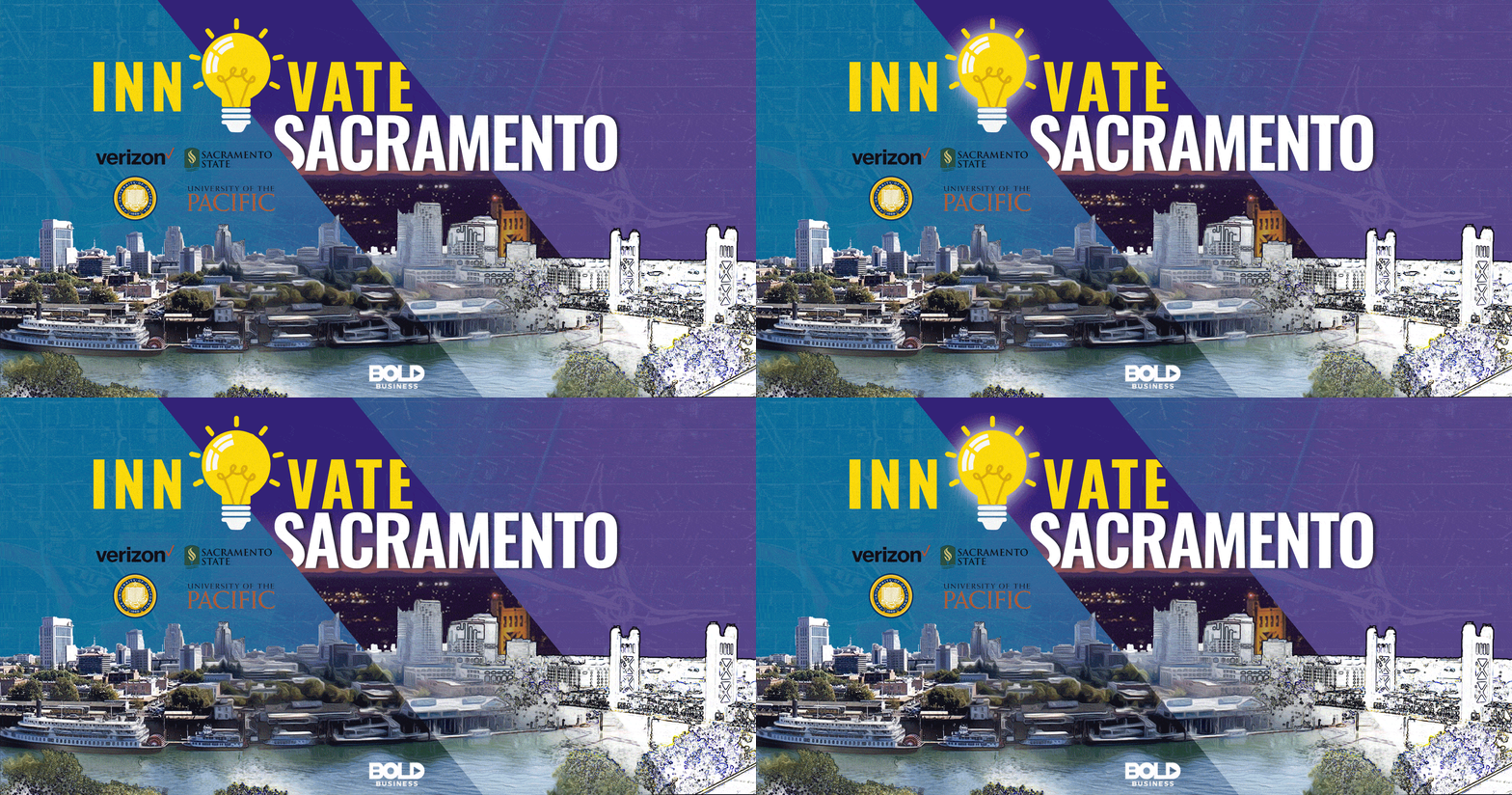
In the recently concluded Innovate Sac event—as part of Sacramento’s celebration of Global Entrepreneurship Week—, the Mayor’s Office for Innovation and Entrepreneurship head Louis Stewart announced that the city would soon become the Sacramento Urban Technology Lab (SUTL). Inspired by Atlanta’s Technology Square, the city would be a hub for innovation and technology.

Triple Helix Innovation Model for Sacramento Urban Technology Lab (SUTL) 


Stewart is aware that the making of Sacramento Urban Technology Lab (SUTL) will take some time, citing the 20 years of development that it took for Atlanta’s Technology Square. He also explained that the Sacramento Urban Technology Lab uses the “triple helix” economic innovation model. The Triple Helix Stanford University thesis posits that economic development requires the combination of elements from the academia, industry and government to initiate social and institutional formats. This step will allow the transformation and application of knowledge. The Sacramento Urban Technology Lab (SUTL) will have seven focus areas: sustainability and clean tech, life sciences and health tech, food innovations, cybersecurity, civic and government tech, the Internet of Things (IoT), and workforce development.

The transformation will require a continuous effort from the community, building from the ground up and pushing innovations out the door. In truth, it would require years of collective work for a mentality of innovation to take root.

Moving Toward a Bold Vision

A practical example of this initiative is the use of the city or parts of it for autonomous vehicles. Sacramento Mayor Darrell Steinberg and other community leaders—including U.S. Rep. Doris Matsui (D-Sacramento)—support these initiatives in building Sacramento as a tech sector. Mayor Steinberg discussed the vision for the city as a place where new things happen and where the Sacramento Urban Technology Lab is not a single building or campus, but the entire city.

Notably, Stewart explained that the announcement does not mean that there would be funding for the projects. Instead, it was meant as a rallying cry for technology companies to make Sacramento a research and development area. The call puts a name to the area’s innovation economy with its numerous resources and the tech companies it encompasses.

On the Aim of Attracting Companies

Markedly, the aim is to attract companies where they can use the city for testing, development and further scaling of technologies with the help of colleges and universities, startups, entrepreneurs, and tech businesses. The idea is to invite tech companies to experiment on Sacramento. Stewart is proud to say that the citizens welcome these innovations and to growing with these tech developments. It is not about selling the idea of Sacramento as a tech-friendly city that invites tech companies with financial benefits. Instead, with the Sacramento Urban Technology Lab (SUTL), the city is packaging itself as a place with an active role in pursuing a continuing discussion of technology—where the city’s identity integrates and influences innovation.

Currently, Sacramento is one of 11 cities in a 5G pilot program by Verizon meant to determine the use and roles of next-gen wireless technologies. The University of California, Davis—located just outside of Sacramento—gives the region an entryway towards funding for tech, as it raised $2.9 billion for research in 2015. It is one of the leading centers for agricultural technology. Other universities in the area include California State University Sacramento (CSU Sacramento) and the University of the Pacific with their own technology programs.

Boldly Looking Beyond the Now

On a related note: Another major aim of the Sacramento Urban Technology Lab (SUTL) is to encourage students from local—particularly, ones with cutting-edge tech programs—and entice them to stay after university. Providing homegrown talents with a venue to operate and share their expertise will aid in the success of SUTL.

Indeed, the Sacramento Urban Technology Lab (SUTL) aims to answer questions about technology and make bold innovations for the future. Current estimates of job loss between 38 percent and 50 percent would have to be offset by new jobs and technologies. Taking the initiative and creating the Sacramento Urban Technology Lab (SUTL) ensures that the region stays relevant as a place where people would want to work.

How can we help?

Bold Business Insights
Privacy Overview

This website uses cookies so that we can provide you with the best user experience possible. Cookie information is stored in your browser and performs functions such as recognising you when you return to our website and helping our team to understand which sections of the website you find most interesting and useful.