Bold Business Logo

Colorado Pushing for $24 Billion Hyperloop

Virgin Hyperloop One is in talks with the Colorado Department of Transportation (DOT) to bring into fruition a hyperloop to service Denver International Airport and nearby cities. They have slated talks and discussions for the next nine months laying the groundwork for the bold project.

Colorado Transportation Initiatives

A strategic partnership between Virgin Group and Hyperloop One, Virgin Hyperloop One had a shot in the arm with the added participation of Richard Branson of Virgin Airlines fame. In October, the company raised an additional $87 million, making its total funds raised to $245 million on a valuation of $700 million. Branson did not state how much he added of the new capital infusion.

So far, Virgin Hyperloop One has been the only one with a working prototype of both the tunnel and pod. In limited short runs at their Nevada desert test site, the pod reached 192 mph in 5 seconds. This was a proof of concept that the technology works.

There are several companies also developing hyperloop solutions, including Elon Musk’s Boring Company, Hyperloop Transportation Technologies and Arrivo. In November, Arrivo disclosed that they are working with Colorado DOT and E-470 Public Highway Authority with a feasibility study for submission by 2018. Once the study’s financials and technical details gets approval, an initial portion of the Colorado hyperloop could start construction by 2019.

Virgin Hyperloop One is looking towards linking Denver International Airport with other cities in Colorado like Vail and Pueblo, as well as Cheyenne in the neighboring state of Wyoming. The expected project cost is $24 billion. However, the initial segment will cost $3 billion connecting Greeley to the airport, a distance of 40 miles (64 kilometers).


Aside from Colorado, other hyperloop projects are under in the discussion stage. The Missouri Hyperloop Coalition wants to have its own hyperloop and are currently raising the funds for it. There is also a proposal to link Mexico City with Guadalajara, a distance of 333 miles (approx. 536 km) by car and theoretically a 45-minute hyperloop ride. Other countries are also interested in having a hyperloop of their own, including the United Arab Emirates and India.

Elon Musk’s Boring Company is in the running to build a loop, connecting Chicago O’Hare Airport to the city, and a 20-minute travel time. However, Musk explains that the project is not a hyperloop, but rather just a loop, because the short distance does not require a partial vacuum in the tube. It will still cut the travel time in half from the current 40 minutes or so.

Hyperloop Concepts

The basis of the hyperloop’s fast speeds is the vacuum (or partial vacuum) inside the tunnel. The pod can run up to 750 miles per hour mph (approx. 1,200 kilometers per hour) due to the lack of air resistance. The pod would be floating on magnets as well, helping ease friction from the rails. The biggest engineering challenge is building the tunnel underground through the long distances the trains are supposed to travel.

There are new hyperloop technologies in either proposal or development stages. So far, Virgin Hyperloop One has been the only one with a working prototype of both the tunnel and pod. In limited short runs at their Nevada desert test site, the pod reached 192 mph in 5 seconds. This was a proof of concept that the technology works. To test for full speed would require a longer distance than its 1,900-foot test track.

For cities and countries interested in hyperloop transportation, the technology can help solve many transportation and network problems. If successful, the bold idea will safely transport passengers and cargo in a faster and more efficient manner.
3D Printing by Using Nano-Particles to Assemble Food

The 3D printing of food started almost as soon as the first 3D printing process was commercially released. One of the first uses of 3D printing, in fact, was in creating chocolate goodies. The bold idea has since evolved into other types of food, with a big jump in the printing materials used.

What sets the new technology apart is the ingredients used in the 3D processing. Instead of finished materials like chocolate, sugar, agar-agar or gelatin, the platform uses nano-cellulose fibers to assemble the food. The food manufacturing follows the diet requirements.

From the Hebrew University of Jerusalem, two professors have developed a 3D printing platform for personalized food. The process and platform allows for the printing of specific food items, including gluten-free, vegetarian, and vegan diets. Using edible zero-calorie nano-cellulose fiber, it can also print special diets for athletes, or for specific food requirements and limitations like those for diabetes and celiac disease.

The Hebrew University’s Prof. Ido Braslavsky presented the new 3D platform at the 3D Printing and Beyond: Current and Future Trends conference. Highlights of the conference included new innovations and technologies from Israeli and international researchers and experts from both industry and the academies.

Prof. Braslavsky heads the Inter-Faculty Biotechnology Program at the Institute of Biochemistry, Food Science and Nutrition, under the university’s Robert H. Smith Faculty of Agriculture, Food and Environment. He collaborated with Prof. Oded Shoseyov who works under the Robert H. Smith Institute of Plant Sciences and Genetics in Agriculture.

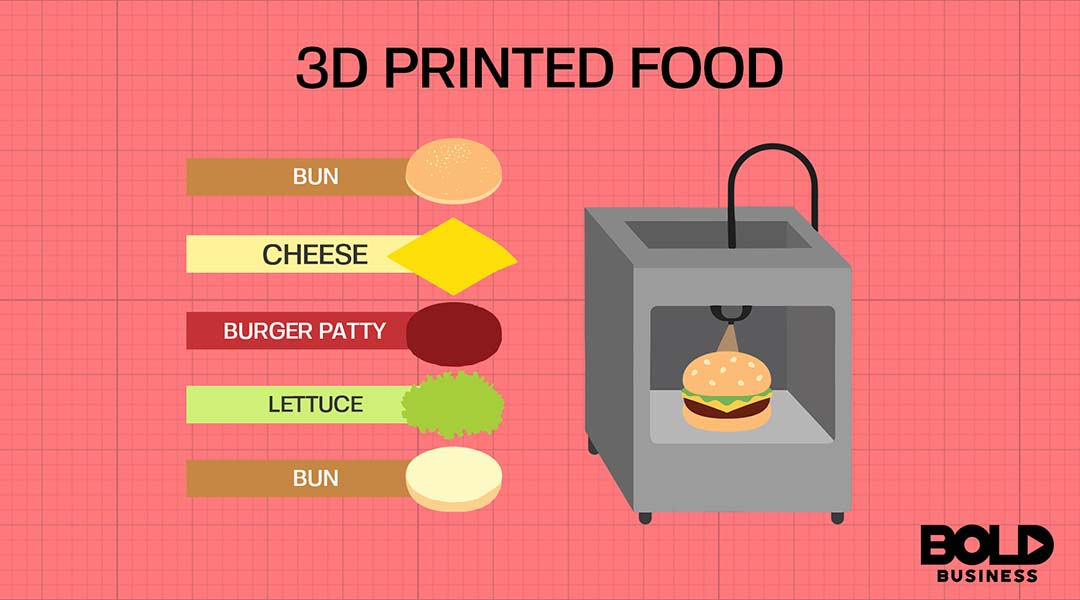
Graphic of a 3D printer and a hamburger

3D Printing Fundamentals

Today’s 3D printers are usually deposition printers. This is an important distinction for food. The 3D printing adds layer upon layer of the same material to form the desired or programmed shape. Called additive manufacturing, it is the most common method used by 3D printers. Newer 3D printing technology uses binding printers, where different materials adhere to one another. For food, this results in a form of edible cement. The process uses the same layer by layer deposit of materials, but it uses different nozzles with different materials.

Using this concept, it is possible for confectioners, chocolatiers, and pastry chefs to create an object which is physically impossible to do by hand. These include objects which look like optical illusions and would be almost impossible to craft to hard. The food extrudes from nozzles and are made from different powdery materials. Lasers and robotic arms are also used to make patterned chocolate, intricate pastry shapes, and sugar sculptures. The 3D Systems ChefJet produces thin layers of crystal from fine-grain sugar creating a wide range of geometric shapes. The Natural Foods Choc Edge 3D printer uses chocolate in syringes to create beautiful patterns and shapes.

One Big Step Further

The above printers are already available on the market. What sets the new technology apart is the ingredients used in the 3D processing. Instead of finished materials like chocolate, sugar, agar-agar or gelatin, the platform uses nano-cellulose fibers to assemble the food. The food manufacturing follows the diet requirements. Using these fibers, it is possible to add and bind proteins, carbohydrates and fats, and to create the food’s texture. The user can cook the food product in several ways while being 3D printed. The 3D printing assembles the food and the user can bake, fry, or grill it separately.

How can we help?

Bold Business Insights
Privacy Overview

This website uses cookies so that we can provide you with the best user experience possible. Cookie information is stored in your browser and performs functions such as recognising you when you return to our website and helping our team to understand which sections of the website you find most interesting and useful.