Bold Business Logo

Senators Push Technology Booster for Transportation

While it may be true that politicians opt for the traditional and familiar, growing transportation woes brought about by an exploding population and dwindling urban space has pushed legislators to boldly embrace technology and all the flighty ideas that come with them.

The proposed law will expand the Smart City Challenge grant program and set aside funds for medium and large communities which will amount to $80 million total.

Recently, two legislators proposed a law that is meant to support and boost high-tech and very advanced transportation systems which make use of big data, cutting-edge technology and other modern solutions.

Sens. Richard Burr (R-N.C.) and Catherine Cortez Masto (D-Nev.) proposed the law amid the realization that flying cars and self-driving vehicles are no longer a figment of the imagination. They are being tested, observed, and will soon be rolled out to the general public.

Their rationale is for more communities to become open to innovations such as the bold idea of Hyperloop transit system, autonomous buses, and flying drone taxis.

No Longer a Question of If, But When

“Our ability to harness technology and innovation is the key to overcoming the problems we face in the 21st century,” Burr was quoted in a report from The Hill. Cortez Masto on the other hand, noted that people’s quality of life will be significantly improved when technology is used to replace transportation systems which are no longer effective.

In the US, antiquated and deteriorating transport systems are threatening the growth of urban centers. According to the Financial Times, trillions of dollars are needed to revive the country’s transport system and bring it up to speed. Advancements were expected when President Donald Trump assumed power, with him bragging of $1 trillion to earmarked for infrastructure projects. People had expected modern train systems or rehabilitated roads and bridges, but until now, there’s still no concrete sign of these programs.

The Burr and Cortez Maso legislation, for its part, will be building on a grant program first established during the Obama administration. This was called the Smart City Challenge, a project which gave federal funding for creative and innovative transportation projects. It covered mid-sized cities in the United States.

How Columbus, Ohio Turned $50 Million to $500 Million

Columbus, Ohio won the Smart City Challenge in June 2016 with the help of its local business community. The city was adept at pulling public-private partnerships, turning $50 to $500 million and cornering pledges and investments from angel investors. The city planned to use electric vehicles to dramatically reduce their carbon emission as well as modernize the transport system.

The government awarded them $40 million which allowed Columbus to deploy three electric self-driving shuttles. These are linked to a new rapid transit center which connects a greater number of the city’s residents to their place of work or business. The city also received an additional $10 million from Vulcan, Inc. Columbus bested 77 other contestants for the Smart City Challenge.

The proposed law will expand the Smart City Challenge grant program and set aside funds for medium and large communities which will amount to $80 million total. There will be two awards each year for medium and large cities.

At the same time, rural communities as well as regional partnerships will be getting two grants per year which amount to $20 million. The law also wants to make sure that 20% of the allotted funds will go to rural development projects. Applicants will also be eligible to apply for additional federal grant opportunities to help advance their tech projects.

These two politicians are clearly looking into future. They have come to the conclusion that other cities in the US must come up with their own transportation programs in order to not be left behind by highly advanced urban centers. More importantly, they understand that the time for bold moves is now.
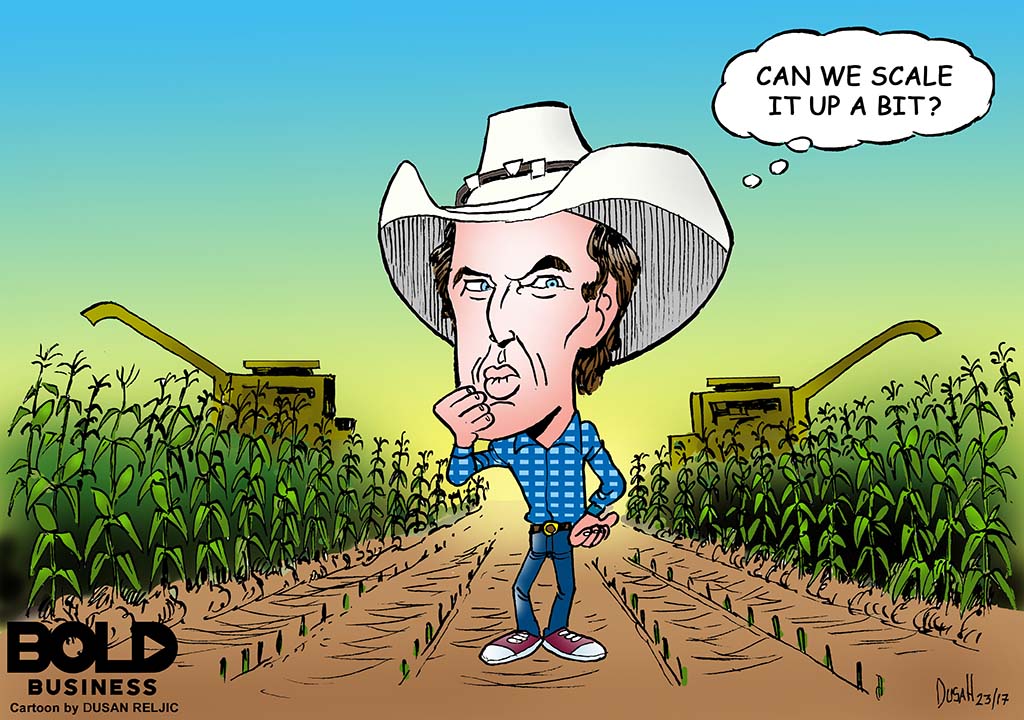
Kimbal Musk Wants to Scale Sustainable Organic Farming

Tech billionaire Kimbal Musk has already conquered Silicon Valley along with his elder brother, Elon Musk. However, Kimbal Musk is on growing food and organic farming, not space travel. This is why Kimbal Musk has made the bold move of buying hundreds of acres of former farmland that he believes is ripe for a food and organic farming.

Kimbal Musk is also ruffling some feathers in the industry – mostly people who don’t believe in “scaling” as much as the Musks do.

The Musks grew up in South Africa; while Elon set his eyes on the stars, Kimbal Musk gaze is turned toward growing food and organic farming. Kimbal Musk says you should nourish the body, as well as the farmer and the planet. His passion for growing food and organic farming is to develop a healthy, local food which is all grown in chemical-free farms.

He’s also campaigning for a boycott of sorts on “organic food,” using his umbrella brand called The Kitchen. The amount of money being thrown in to develop a portfolio of food-related projects and creating partnerships with foundations and governments in various cities is significant enough to make him get noticed.

Kimbal Musk non-profit organization has already opened 425 teaching gardens in schools all over Chicago, Los Angeles, Memphis, and Colorado. His ex-wife Jen Lewin helped design the modular curved plastic planters that are placed in the schoolyards. They come with instructions and can be used to teach kids science. The Kitchen Community has been installing such schoolyard gardens since 2011.

Passion for Food and Organic Farming

Kimbal Musk is a successful tech billionaire thanks to the influence of his brother, Elon. Together, they scored their first win when they sold Zip2 to Compaq Computer in 1999. The company helped create online city guides, and this was sold for $307 million. He also has investments in PayPal, Tesla, and Space X.

However, he was the one who grew up in the family kitchen, making meals for their family since he was 12. Their mother Maye was a model and dietician while their father Errol was an engineer and pilot.

So when Kimbal Musk had enough money and experience from the tech industry, he went back and enrolled at the French Culinary Institute. Living in New York City at the time of the 9/11 attacks, Kimbal Musk volunteered as a cook for firefighters and rescue workers for six weeks. At this point, he discovered the connection between food and the community.

By 2004, Kimbal Musk opened The Kitchen in Colorado. The restaurant boasted of farm-to-table cooking and became an instant success. Despite his feats, it was after an accident during a family vacation in Wyoming that he decided that his life would be devoted to growing food and organic farming and to educate people on how to improve it sustainably.

Organic Farming

Kimbal Musk set up another branch of his restaurant at Shelby Farms, Memphis. However, he insisted on buying 300 acres of former cotton farmlands. His plan is to transform it to chemical-free farms into growing food and organic farming, coupled with smaller takeout spots that will sell meals made from locally-grown produce at really affordable prices.

Kimbal Musk is also ruffling some feathers in the industry – mostly people who don’t believe in “scaling” as much as the Musk’s do. There are also some comments that Kimbal’s organic farming approaches is to not let their his hands get dirty since they use technology and innovations.

In spite of all these, Kimbal Musk carries on with his food and organic farm dream with bold moves and cares for everyone.

How can we help?

Bold Business Insights
Privacy Overview

This website uses cookies so that we can provide you with the best user experience possible. Cookie information is stored in your browser and performs functions such as recognising you when you return to our website and helping our team to understand which sections of the website you find most interesting and useful.