Bold Business Logo

NASA’s New Space Fabric of the Future – 4D Printing Technology

NASA is an innovation hothouse, but we don’t expect fabric to be high on their list of must-dos. Then again, a few moments of thought and you realize that protective comfortable fabric that can withstand the rigors of space, yet be comfortable and flexible would be one of the most important innovations they would be working on.

We call it 4D printing because we can print both the geometry and the function of these materials.

True to their reputation, NASA is on it, with a new fabric that is almost miraculous. Its so-called ‘space fabric’ is currently making an impression on the world of technology. Engineers from NASA developed a prototype space fabric that could help astronauts in their missions.

The National Aeronautics and Space Administration (NASA) is an independent U.S. agency that is responsible for various space programs. NASA is the U.S. center for aerospace research and aeronautics.

Over the years, NASA has produced many worthwhile inventions that are innovative and helpful. A group of engineers headed by Raul Pilot Casillas, a System Engineer from the Jet Propulsion Laboratory(JPL) of NASA, created an advanced space fabric. The space fabric is made using 3D printings. The 3D-printed material is foldable, enabling it to shapeshift.

3D printing is an additive manufacturing process that develops an object from a digital design. The object is made by means of laying down successive layers of material until it is finished. NASAs breakthrough new process is being called 4D printing.

Casillas said, “we call it 4D printing because we can print both the geometry and the function of these materials”. He added that “if 20th Century manufacturing was driven by mass production, then this is the mass production of functions”.

The space fabric is made out of interconnected stainless steel squares. It was based on the image and likeness of chain mail. The sides of the fabric reflect and absorb light, providing a passive mechanism for thermal regulation.

How Will Space Fabric Become Beneficial in the Future?

A picture of a shirt in a 3D printing and close-up of the fabric

NASA provided possible usage for the space fabric in the future. The fabric could be used for:

  • Big antennas and other deployable devices.
  • Protecting space craft from meteorites.
  • Improving astronauts’ spacesuits.
  • Getting objects on the surface of another planet.
  • Insulating the spacecraft.

Casillas grew up around fabrics because his mother is a fashion designer from Spain. With his background, Casillas also mentioned that the chain mail-like fabric could also be used for fashion.

Other Breakthroughs of 3D Printing

Aside from the NASA’s space fabric, 3D –printers can also develop other inventions. Network World has provided 10 coolest things that were made on 3D printers:

  • The Prince Urn – The 3D-printed ceramic urn for the late Prince was designed by Foreverence. It is a scale model of Prince’s residence in Chanhassen, Minnesota.
  • Guitars – Odd Guitars is a company that uses 3D printing in order to customize the guitars as requested. The company uses the 3D printing technology called Selective Laser Sintering to create the guitar body.
  • Robotic lawnmower – The 3D-printed robotic lawnmower of Reprap Windturbine drives within a boundary wire fence. The robotic lawnmower called Ardumower is driven by two 12V geared motors.
  • Bionic Arm – Exii has developed a bionic arm called HACKberry. It is a 3D-printable electric prosthetic arm.
  • Ears and human tissue – Regenerative medicine scientists at Wake Forest Institute for Regenerative Medicine have made a 3D bioprinter. The invention can make replacement tissue strong enough to endure transplantation.
  • Eagle beak – An eagle named Beauty had been shot in the face by a poacher in Alaska. With the help of a 3D printer, Beauty was able to have her beak back.
  • Titanium bike frame – Chris Williams, the Managing Director at Empire Cycles, has designed the first metal 3D-printed bicycle frame. MX6-EVO was made using Renishaw’s additive manufacturing technology.
  • Drones – BonaDrone has modified a drone using a 3D printer. It developed the Mosquito drone.
  • Candy – Chef Jet is a food printer from 3D Systems which makes ‘custom edible geometries’ from milk chocolate or sugar.
  • Self-driving car – DigiRobotics is a company based in UAE. It developed WiGo, a 3D printed autonomous car. WiGo’s body was 3D-printed in Dubai using a six-axis, which is a large-scale 3D printer.

NASA’s space fabric can revolutionize the way that spacecraft are engineered. It has taken a different path in order to contribute to aerospace technologies. The space agency beleives the fabric has huge potential for the future.

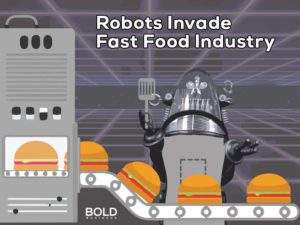


Automation In Fast Food Industry – Robots Taking Over

After acquiring $18 million in venture funding, Momentum Machines, a company that developed the first robot grill master, is one step closer to opening its first fast food restaurant. It will be located in San Francisco, although there’s no word yet on its opening date.

In 2012, Momentum Machines launched the Autonomous Grill Master, a robot that slices, grills, assembles, and bags burgers in just an hour. Founders Alex Vardakostas and Steven Frehn tried to revolutionize the way food is prepared. Now, the robotics company has secured venture funding and is ready to take over the automation in fast food industry.

Our device isn’t meant to make employees more efficient but it’s meant to completely obviate them.

Momentum Machines is made up of roboticists from Tesla, NASA, Stanford, and Berkeley. Business Insider states that Momentum Machines received investments from top VC firms like Khosla Ventures and Google Ventures in the past.

The robot of Momentum Machines is being reinvented and it is made up of the following:

  • Oven – The oven is capable of gourmet cooking techniques that were never before used in a fast food restaurant.
  • Stamper – The stamper stamps and grinds fresh custom blends of meat only after the burger is ordered.
  • Slicer – The robot slices fresh ingredients only after the order is placed. It creates the freshest burger possible.
  • Bagger – It is the final stage of the robot. It produces a perfectly bagged hamburger.

The machine slice toppings like pickles and tomatoes immediately before the burger is served. It ensures that everything is fresh as possible, even in fast food restaurants.

One advantage of the machine is its size. It only occupies up to 24-square feet, creating a good overall dining room experience and a spacious seating.

The technology that Momentum Machines offers has attracted the attention of some big names in the fast food industry. McDonald’s is already showing interest in the robot.

Ed Rensi, the former CEO of McDonald’s, says “it’s cheaper to buy a $35,000 robotic arm than it is to hire an employee who’s inefficient making $15 an hour bagging French fries”.

Attributes of the Autonomous Grill Master

A robot making hamburgers - an example of automation in fast food industry.

  • The robot is only $35,000.
  • It costs less than a year’s pay for a $15 per hour worker.
  • The machine is equipped with AI smart technology.
  • The robot is more sanitary than humans.
  • It creates better burgers faster than humans.
  • The robot has the capacity to replace two to three full-time line cooks.
  • It saves a total of $90,000 in salaries, training, and overhaul costs.

Vardakostas said in a statement for Xconomy that “our device isn’t meant to make employees more efficient but it’s meant to completely obviate them.”

The funding boost that Momentum Machines received has brought back old fears that machines could soon replace human employees in the fast food industry.

The robotics company believes that letting robots fill in for humans in the kitchen may promote overall job growth. The automation is going to allow the company to employ new staff to continue developing their technology.

San Francisco Embracing Robot Technology

People in San Francisco, where Momentum Machines plans to have its first restaurant, have been working toward the concept that their restaurant experience will have minimal human interaction.

Eatsa, a futuristic food-chain, opened its doors in 2015. The vegetarian company specializes in quinoa bowls with an automated pick-up and ordering process.

Evidence that artificial intelligence could replace human workers is seen in San Francisco. For instance, robots run food deliveries for Yelp’s Eat24. They also pour coffee at Café X.

Around the same time, Momentum Machines applied for a building permit at 680 Folsom Street in San Francisco, California, it also listed a job posting on Craigslist. It is looking for Restaurant Generalists, not burger flippers. Craigslist is an American classified advertisements website with sections dedicated to housing, jobs, personals, items wanted, for sale, community, services, resumes, gigs, and discussion forums.

The continuous innovation of machines is already being felt everywhere. From the field of medicine to the restaurant industry, artificial intelligence is starting to take over jobs that were once being done by humans. People need to realize that technology is evolving and that it’s time to relax and let machines do the work.

Society may see the invasion of robots in a negative way but the good thing is that they promise a life of leisure. Our first glimpse of the future is exciting.


How can we help?

Bold Business Insights
Privacy Overview

This website uses cookies so that we can provide you with the best user experience possible. Cookie information is stored in your browser and performs functions such as recognising you when you return to our website and helping our team to understand which sections of the website you find most interesting and useful.