
Bold Business Logo

Government Spending Must Increase For Cybersecurity

Time and time again the US government has been criticized for not spending enough on cybersecurity to protect its data against cyber-attacks, and the budget may be the reason why.

Over the past two years, cyber-attacks from Russia and China have infiltrated everything from the US election results to the Pentagon’s Joint Chiefs of Staff’s email to the personal information of 7% of all government employees. There were also reports that foreign hacks had managed to identify and track the whereabouts of intelligence officers.

Government Funding for Cybersecurity

According to Business Insider, although the spending on cybersecurity has increased to more than $12 billion a year, so has the number of attacks, and the budget to protect sensitive data just isn’t enough.
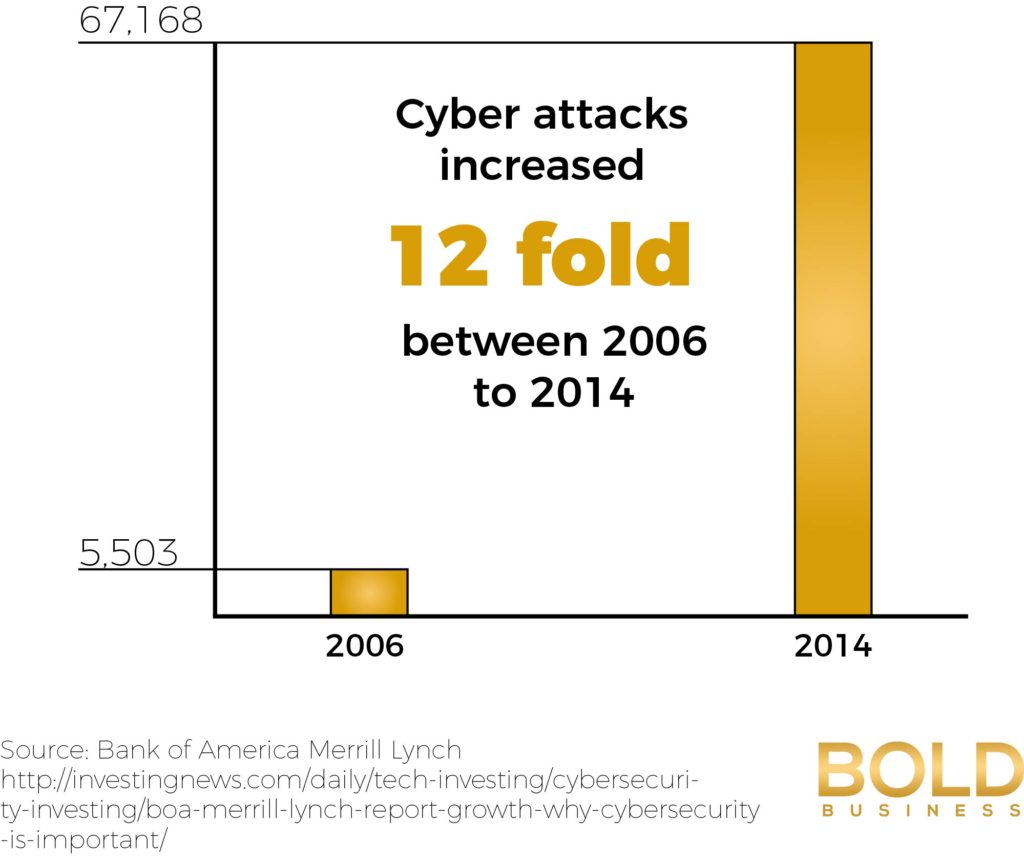
The need to increase cybersecurity spendingData taken from a study by Bank of American Merrill Lynch showed that cyber attacks increased 12-fold between 2006 to 2014, from 5,503 to 67,168.

Results showed that the amount US departments are spending on protecting against these attacks is extremely low, and only the Department of Homeland Security spends more than 3% of its budget on cybersecurity.

Statistics show that a staggering 11 federal departments spent less than 1% of their budget on cybersecurity in 2015.

The FBI is now the lead federal agency for investigating cyber-attacks by criminals, overseas adversaries, and terrorists, and is doing all it can to tackle the issues. Cyber intrusions are becoming more commonplace, more dangerous, and more sophisticated, the agency states.

Who is the National Cyber Security Alliance?

According to CNNTech, Michael Kaiser, executive director of the National Cyber Security Alliance (NCSA), has said that this must change and we need to become more cybersecurity vigilant.

Funded in part by the Department of Homeland Security, the NCSA works to educate people about cybersecurity and how to combat attacks.

Kaiser told CNNTech that more emphasis should be made on cybersecurity in the United States. “More of the population uses technology than drives,” Kaiser said. “And the car culture that we live in is omnipresent and requires everyone to have a basic level of doing it well. Otherwise, people would be getting hit by cars all the time. The same is true of cyber.”

In a term, reminiscent of driving safety culture, the NCSA has adopted the slogan “Stop. Think. Connect” to try and educate people on the importance of protecting their data.

“Stop. Think. Connect.” – National Cyber Security Alliance

Hackers Continue to Innovate

Despite these steps, cyber-attacks and more recently ransomware are a growing threat as hackers continue to hold organizations to ransom to release their systems and personal data.

The NCSA is trying to encourage members of the public, independent corporations, and even government agencies to adopt stricter and tighter online security measures to protect themselves, but each time a new security wall is created hackers find a way to break through it.

Despite technological advancements and the latest innovative solutions, there will always be the threat of cyber-attacks.

As 2017 throws up yet more threats to our security, the government would be wise to increase its spend on cybersecurity. As the digital age intensifies, and as we continue to live our lives on digital platforms, cyber-attacks are most definitely the greatest threat to our security this millennium.
2017 Biggest Cybersecurity Threats

Cyber-attacks have become the greatest threat to our security since the cold war era. The director of the FBI recently said that cyber threats are a constant focus of the agency and he is determined to tackle cybersecurity head on.

In fact, online security has become the focus for internet-based firms globally as cyber-attacks and hacking have increased 12-fold.

According to a study by software security firm Symantec, US companies are losing more than $525 million annually because of cybercrime. Attacks against nations, organizations and businesses hit the headlines so often that we’ve become accustomed to the number of cyber threats out there. The most recent of course being the accusations made by security agencies that Russia hacked the US elections.

However, these threats are not just aimed at governments and nations, but everyday people are also being targeted. The FBI says that “American companies are targeted for trade secrets and other sensitive corporate data, and universities for their cutting-edge research and development” and “citizens are targeted by fraudsters and identity thieves”.

“American companies are targeted for trade secrets and other sensitive corporate data, and universities for their cutting-edge research and development”

With many of us using the internet for online banking, booking flights, and processing our most sensitive data through online platforms, we face the distinct possibility that our details could be stolen at any second, bank accounts cleared and our identities cloned.

Passwords, pin codes and encryption are no longer proving a deterrent to online hackers who continue to build a healthy living through cybercrime.

Internet firms like Cloudflare provide increased security options for individuals, leading websites, organizations and businesses to protect against such threats. However, even they are proving fallible.

Cloudflare recently revealed that a bug infiltrated their system causing sensitive user data to be leaked across the internet, placing private client data such as passwords and login details into the coding of other websites. The company has since improved its security, but if the very organizations designed to protect us are penetrable it only emphasizes how important cyber threats have become.

What’s more, the increase in “internet of things” gadgets being controlled via online platforms has led to an increased susceptibility of attack. Interconnectivity comes at a cost as anything from net-connected CCTV cameras, televisions, household appliances and media servers can be compromised.

To help combat these attacks, Symantec is just one leading tech firm producing ‘super routers’ that can block bad data before it even enters a home or business network. More sophisticated forms of protection are also being developed daily for government agencies and larger corporations.

Despite innovation and technological advancements, there will always be the threat of attack. Wired.com says that 2017 will throw up yet more challenges for security firms as they struggle to tackle the latest hacking devices and cyber masterminds.

The use of drones in army combat will grow dramatically over the next five years. Small drones the size of a remote-controlled cars will soon be able to fire shots or drop bombs on unsuspecting targets. The threat of cyber-attack on such devices throws up many unthinkable consequences, such as: death to innocent citizens or even inciting war.

2017 Security Threats - CybersecurityLast year, the Telegraph reported that US-allied Kurdish soldiers were killed by a small drone, rigged with explosives. According to the report, the US government is already buying drone-jamming hardware and looking at geo-fencing technology to stop drones flying into sensitive areas.

Another issue facing authorities is when they want to hack sensitive data. This issue raised its ugly head when the FBI tried to force Apple into rewriting their own coding to infiltrate the iPhone device of the San Bernadino terrorist. Apple put up a good fight to the FBI’s requests and the agency only backed down when they figured out their own way of cracking the code.

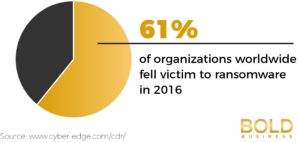
Ransomware attacks are also set to increase this year, according to Sputnik News. Research showed how a third of businesses were infected with ransomware globally in 2016. CyberEdge research found that 61% of organizations worldwide fell victim to ransomware in 2016 and ended up paying the fee demanded by hackers.

The relatively new term has become a billion-dollar business for cybercriminals who are holding people, businesses, organizations and governments to ransom by hacking their systems. What’s more, they are using ransomware to extort money out of hospitals or government agencies by holding extremely sensitive and potentially damaging information.

Many critics say the best way to combat such attacks is by increasing government spending on cybersecurity but the biggest and boldest impacts will come from both the government and private sectors.

How can we help?

Bold Business Insights
Privacy Overview

This website uses cookies so that we can provide you with the best user experience possible. Cookie information is stored in your browser and performs functions such as recognising you when you return to our website and helping our team to understand which sections of the website you find most interesting and useful.