
Bold Business Logo

The Art of the Corporate Turnaround: Why It Requires a Special Skill Set

There have been countless corporate turnarounds of industry giants championed by notable leaders. Some examples include General Electric under Jack Welch, Lee Iacocca at Ford, and Steve Jobs when he returned to Apple, to name a few. When a company’s survival is at stake, leadership is crucial. Typically, successful turnarounds are pioneered by executives who lead by example, are not afraid to roll up their sleeves, and can rally the troops toward the common goal of transforming the company. They assign the right managers with appropriate empowerment to drive the company’s mission. Most importantly, they offer a unique set of soft skills that help them provide an empathetic, humane touch and create an environment of collective growth.

Is a Consultant the Best Option?

people showing key leadership skills
There are key leadership skills that are essential to a successful corporate turnaround.

When facing a corporate turnaround, some businesses look to outside consultants for a fresh set of eyes and expertise in identifying problems, increasing profits, decreasing costs, and improving cash flow. While a third party may have technical experience in transforming an organization, an outside specialist cannot truly understand the dynamics and synergies involved within an organization.

Often, the first recommendation from an outside consultant is to change the leadership team. But that may not be the best decision, especially if those executives were the ones who led the company to uncharted heights. Another consideration is how long it would take a new executive team to settle in and get to know the key players in the corporate structure. Rather than cleaning house from the top down, it might be more effective to leave the top management in place and invite more input from throughout the organization. Effective corporate turnarounds require participation from all levels—from the C-suite to the production floor to marketing to software developers. In fact, instead of using a consultant with no ties to the corporation, a better option may be to engage internal stakeholders and shareholders for new perspectives on what the problems are and how to turn around the organization.

Coporate Leadership Skills–Or Lack Thereof

Before making changes within the organization, it’s essential to determine the issues that brought the company to its current state. Some of these factors may be intangible, such as confusing messages from corporate leadership about the organization’s priorities. A narrative that changes regularly can contribute to decreased employee motivation, especially if putting out fires due to poor real-time decision-making becomes an everyday occurrence. An “on the fly” mentality makes it harder to establish a baseline when trying to rebuild.

Another common characteristic of failing companies is a crumbling culture. Perhaps employees could not and did not connect to the mission of the organization. Or maybe they feel underappreciated and undervalued for their contributions to the organization.

More tangible issues that can drag a business down may include too many non-core activities and legacy product lines that are no longer profitable or consistent with the current corporate image. For example, Jack Welch spent much of his 20-year tenure as General Electric’s CEO focused on getting the right people in the right places. By doing this, he increased employee buy-in and success, even as he took the company past its lightbulbs and appliances pedigree into industrial products and financial services. Welch had his critics, but revenues expanded, and share prices spiked. Multiple vehicle manufacturers have discontinued classic models and even entire product lines, such as Chrysler did in 2001 when it decided Plymouth was no longer profitable.
a dude showing off corporate leadership skills

Characteristics of an Effective Turnaround Leader

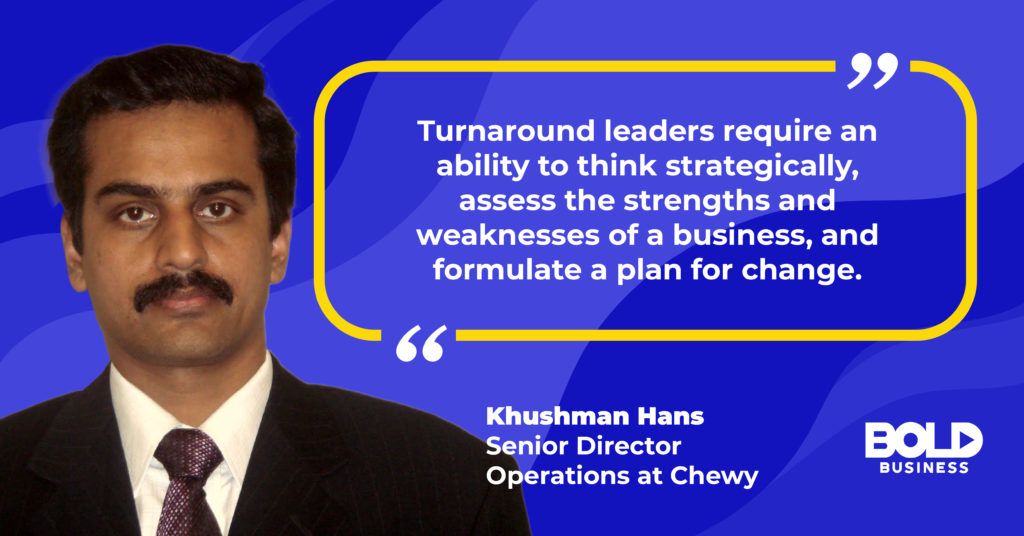
Turnaround management is a challenging task that requires a unique set of skills to overcome challenges and drive organizational success. Turnaround leaders require an ability to think strategically, assess the strengths and weaknesses of a business, and formulate a plan for change. But most importantly, they need to possess powerful interpersonal skills that will build the relationships and confidence necessary to create change effectively and efficiently.

When change is afoot, empathy goes a long way with employees. Corporate turnarounds may involve moving people or divisions elsewhere, shutting down legacy lines, or laying off individuals or even entire teams. The best managers approach those situations with an empathic touch, showing compassion for the lives that may be disrupted. This approach leaves organizations with intact reputations that new candidates may remember when hiring is on the upswing again. Explaining the “why” behind moves made at every level as part of the turnaround is critical.

The other part of the equation, after getting buy-in that difficult changes were necessary, is driving the workplace toward a common goal or mission. The requires having a clear vision of what “success” truly is and communicating and embodying that mission with employees at every level. Leaders must be seen and fully engaged, not just checking in with regular edicts by e-mail.

Successful turnaround leaders exude optimism. If they don’t truly believe in what they are doing and how change will benefit the organization, the troops won’t follow suit. Optimism builds confidence. At a time when morale is typically low, it is essential to develop wide-reaching support from throughout and beyond the organization. Doing this creates a renewed sense of purpose and pride.

Mastering the Successful Turnaround

Struggling businesses fail all the time in every industry. Some are bailed out and sold at discounted prices to competitors who did not suffer the same fate. Others simply fade away, overtaken by companies with a superior workplace culture. Successful corporate turnarounds are notable as they are commanded by leaders who engage the entire workforce with empathy, compassion, and inspiration. What sets these leaders apart from others is their exemplary soft skills, intuition, superior technical ability, and the capability to be truly inspirational leaders.


About the Author:

Khushman Hans is an operations executive who has led cross functional teams in strategic quality control and productivity projects for multiple business units. His background includes process engineering, supply chain management, and continuous improvement for a number of national distribution and fulfilment centers. For more information, contact khushman@gmail.com.

Bold Opinion: It Was Time for Affirmative Action to Go

On June 29th, 2023, the U.S. Supreme Court ruled that Affirmative Action policies could no longer be justified in admittance to higher education institutions. In a case involving both Harvard University and the University of North Carolina, the majority of Justices failed to see the benefits of these policies. They were correct. While Affirmative Action in the United States was previously needed and perhaps beneficial, there have since been simply too many Affirmative Action examples leading to wrongful discriminations. Modern discriminations may not be the same as those that these original measures sought to eliminate… but they highlight the modern hypocrisy that Affirmative Action policies have come to represent.

the Supreme Court and Affirmative Action in the United States
Affirmative Action in the United States–at least when it comes to colleges and universities–is dead. Finally.

Naturally, there are those who applauded the Court’s ruling, as well as many who criticized it. Such lines tend to fall along liberal versus conservative points of view. But let’s take a step back and look at Affirmative Action in the United States in a more objective manner. Did Affirmative Action achieve what it was supposed to achieve? And even if it did so early on, is it continuing to address existing discriminations today among university students? Do modern Affirmative Action examples enhance diversity, equity and inclusion while promoting meritocracy? And is Affirmative Action really the progressive policy advancing higher learning in the country for the future? The answers to these questions should be the ones that best determine the fate of Affirmative Action in the United States.

(Previously, Bold has written about the importance of diversity, equity and inclusion in the workplace–check it out here.)

The Good Intentions of Affirmative Action

The origins of Affirmative Action in the United States dates back to 1961. President Kennedy issued an executive order pertaining the to fair hiring of government contractors. Such hires should be made without regard to race, creed, color, or national origin. It would not be long before similar Affirmative Action policies be adopted by other entities including public colleges and universities. The goal, of course, was to overcome longstanding racial discriminations that had been created via slavery and Jim Crow laws. In this regard, Affirmative Action was to help racial minorities overcome barriers of influence, affluence, and privilege. And to some extent, it did help achieve a more even playing field for college admissions.

In the years to follow, challenges to Affirmative Action gradually increased, especially within the legal system. There were a number of various Affirmative Action examples where policies failed to promote true equality and anti-discrimination. Courts eventually ruled that implementing racial quotas to achieve desired student race percentages was unconstitutional. This led colleges and universities to shift gears in how they approached admissions. Under the concept of “racially conscious” admission decisions, universities sought to diversify student bodies for the benefit of students. In other words, Affirmative Action was no longer being used to overcome racial barriers of America’s past. Instead, it was being used to ensure students could be exposed to racially diverse points of view.

the scales of justice, a gavel and a flag
The scales of justice can take more than half a century to find balance, but hopefully the Supreme Court’s recent ruling helps us find that equilibrium.

Affirmative Action’s Reality in the United States

Since the implementation of Affirmative Action in the United States, research has supported the advantages of diversity, inclusion, and equity. From this perspective, it might be presumed that a racially diverse student body would offer benefits. But such a view is narrow-minded and fails to embrace the true nature of diversity. While student experiences are greatly affected by race, this is only one factor that comprises diversity. Gender, sexual orientation, ethnicity, and religious practices, and socioeconomic factors are others. The problem in reality is that schools focused too heavily on race without honoring other components of diversity. It’s therefore not surprising that modern Affirmative Action examples fall well short of the intended mark.

(Diversity and inclusion can be ingrained in a growing company–here are five steps to take, courtesy of Bold.)

The shortcomings of Affirmative Action in the United States today are well documented. Some notable examples include medical school enrolments. According to the Association of American Medical Colleges (AAMC), marked discrepancies in GPAs and MCAT scores exist among racial groups. For African American students accepted, the average GPA is 3.55 with MCAT scores in the 64th percentile. Yet, for Asian Americans, the average GPA is 3.80 with MCAT scores in the 89th percentile range. In other words, the bar is set much lower for African Americans than it is for Asian Americans simply based in race. Affirmative Action examples like this lie at the heart of the recent U.S. Supreme court case. Affirmative Action in the United States has made it easier for some racial minorities but not others. Basically, the reality of these policies is that they have simply shifted one process of racial discrimination for another.

Expanding the Diversity Wheel

the Supreme Court didn't like the Affirmative Action examples
There have been countless Affirmative Action examples where outcomes were less than optimal. Well, the Supreme Court has now fixed it!

Under the current admissions processes, universities and colleges continue to discriminate based on a variety of factors. This is certainly true of some of the most prestigious universities. Affirmative Action examples certainly show that reverse racial discriminations are occurring commonly among some schools. But beyond this, many schools discriminate according to additional variables. Relatives of school donors often receive preferential consideration as do children of college professors and staff. Athletic abilities and whether or not a parent is an alumni of a college also affected admission decisions. Indeed, Affirmative Action in the United States has undermined academic meritocracy based on race. But race is definitely not the only issue negatively affecting equality of opportunity in modern times.

Understanding this, there’s little question that Affirmative Action in the United States has run its course. It might have helped in its early years, allowing racial minorities to overcome longstanding obstacles to higher education. But Affirmative Action examples today show it fuels its own versions of racial discrimination, which it was supposed to address. In short, Affirmative Action was too narrowly focused to be truly effective. This level of government oversight was never meant to be a long-term solution but instead a catalyst for change. Fortunately, Affirmative action has come to an end, hopefully paving the way for a better approach.

It’s time for colleges and universities to honor the very concept of diversity, equity, and inclusion they claim to pursue. This means expanding the diversity wheel to include more than just gender, race, and ethnicity. It means diversifying on the basis of socioeconomic status, religion, political ideologies, and so much more. This will not be accomplished through broad policies but instead through individual student considerations. And it won’t be achieved as long as influence, affluence, and privilege are allowed to contaminate the admissions process.


Too much government oversight can be a bad thing–read about how they wanted to take our whipped cream in this Bold story.

How can we help?

Bold Business Insights
Privacy Overview

This website uses cookies so that we can provide you with the best user experience possible. Cookie information is stored in your browser and performs functions such as recognising you when you return to our website and helping our team to understand which sections of the website you find most interesting and useful.