
Bold Business Logo

5 Unexpected Benefits of On-Demand Webinars (SPONSORED CONTENT)

Most people consider an on-demand webinar to be nothing more than a recording of a live webinar. It’s a video you can conveniently watch at any time, somewhere like YouTube. 

On-demand webinars of this kind have two big benefits:

  • Scalability: A pre-recorded webinar can be watched 1000X over, unlike a live webinar which is tied to the availability of the host.
  • Time saved: Time that would have been spent hosting a live webinar can be spent on other things.

The big problem, however, is that a traditional on-demand webinar is impersonal, a passive viewing experience that doesn’t share the characteristics of a “real” webinar.

Fortunately, on-demand webinar software has come a long way and now delivers benefits that are entirely unexpected. So much so, most people don’t even know they exist.

Here are the five most unexpected benefits of modern on-demand webinars:

  1. Increased attendance
  2. More opportunities for interaction
  3. Longer watch times
  4. Higher engagement
  5. A personal touch at scale
Someone using an on-demand webinar platform service
If you’re considering conducting a webinar, look into the eWebinar service.

1. Increased attendance

With the advent of Netflix and other streaming services, consumer expectations have changed with respect to how accessible video content should be. People want everything to be available at their convenience, whether that’s “right now” or at a time that fits nicely into their schedule. On-demand webinars meet this demand and the result is higher attendance rates.

When you are choosing webinar software, however, be sure to look for a product with more availability options than just “on demand” — there are a few out there — including things like a recurring schedule, just-in-time sessions, and webinars replays. It is the power of these scheduling features combined that makes attendance rates go up so much. The average attendance rate across all of eWebinar’s users, for example, is 65% — 63% higher than the industry average of 40%

2. More opportunities for interaction

Webinars are meant to be interactive. Attendees expect to be able to ask questions, whether through chat or during a Q&A at the end. And the audience is often asked to participate in the experience by responding to questions and polls or by sharing feedback. It’s a big part of what makes a webinar a webinar.

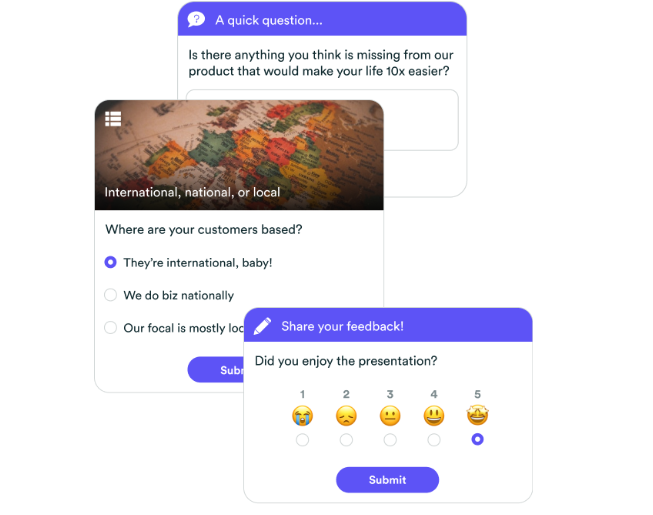
While it might seem counterintuitive, on-demand webinars can offer attendees more opportunities for interaction than most live webinars. This is because you can plan your script and program interactions — like questions, polls, tips, special offers, and more — to appear automatically throughout your webinar at predetermined times, giving your audience a way to participate in the experience from beginning to end.
3. Longer watch times

The natural result of more opportunities for interaction is longer watch times. Without something to hold their attention, people can easily get distracted and switch to another browser tab or open Instagram. Interactivity is the thing that keeps them watching longer, so they don’t miss your all-important CTA at the end. 

For example, one company switched from a different webinar platform to eWebinar and added interactions to the exact same video they had used before. The result was that their watch times increased from 70% to 90%. This is typical.

Other platforms that offer a variety of interactive elements are Bigmarker and WebinarGeek.

4. Higher engagement

Another byproduct of greater interactivity is higher engagement all around. When people respond to your polls and questions or reach out to you with their own questions through chat, a feedback loop is created that becomes an invaluable source of actionable information. You can find out who your audience is and what they are looking for. Or learn how to improve your product or service. Or use the data you collect to predict behavior, such as the likelihood of purchasing. 

Whatever your goal, all of this data, including behavioral data captured for you automatically, can be sent to your CRM or marketing automation software of choice for audience segmentation and targeted post-webinar follow-up.

5. A personal touch at scale

Finally, the last benefit of modern on-demand webinars — a personal touch at scale — springs from having a robust chat system.

To help demonstrate this benefit, here is how eWebinar’s chat works for attendees and hosts:

How chat works for attendees

A personalized chat message welcomes attendees to the webinar shortly after they join. This lets them know they can ask questions at any time during the presentation, instead of having to wait for a Q&A. 

Because chat is one-on-one and private — not public as it is in live webinars — attendees have a direct line of communication to you. They don’t have to worry about their questions not getting answered, which makes them feel extra special and heard.

How chat works for the webinar’s host

When an attendee sends a message, the webinar’s host — or team, since you can assign whoever you like to assist you with moderating chat — gets notified. 

If the host is free, they can jump in and have a real-time conversation with the attendee. This gives them the golden opportunity to answer questions, resolve objections, and close deals in the moment — and to offer exceptional customer service. 

If, on the other hand, the host is not free to respond, an auto response lets the attendee know that their message was received and that someone will get back to them later. (This puts the attendee at ease and keeps them from feeling ignored.) If the host is still unable to respond before the webinar ends, their reply gets sent to the attendee by email automatically. 

The flexibility of this system lets you run your webinars around the clock without worrying about missing a question or leaving an attendee hanging without a response. It also ensures that attendees can always get answers to their questions. It strikes a balance between the importance of offering on-demand content and the personal touch of direct, one-on-one communication — at scale.

Conclusion

If you were surprised to learn about any or all of these unexpected benefits of on-demand webinars and are interested in experiencing them for yourself, there are a number of software options out there for you to try. Whether you choose to go with eWebinar or something else, I hope you will come to realize that the preconceptions people have about on-demand webinars are no longer true and that you can make your webinars available in a way that is convenient for attendees without sacrificing the things that make webinars special: interactivity and chat.


Underground Economy Series: The Business of Sex Work

[Editor’s note: Welcome to the Underground Economy series, which delves into the business of illicit, under-the-table, or otherwise accepted-but-not-quite industries. Today’s installment deals with the sex worker industry!]

When it comes to the sex worker industry, facts and statistics can be difficult to find. For one thing, the industry involves a diverse set of individuals. Some pursue sex work voluntarily while others are coerced or trafficked. Similarly, the actual type of sex work varies as well, including phone sex workers as well as prostitutes. But no matter the situation, sex worker tax evasion has been identified as a potential national issue. Sex worker tax risks exist regardless of whether they choose to file or not. And both sets of risks influence the ultimate choice sex workers make regarding their taxes.

Sex worker tax evasion in action
Sex worker tax evasion is a prevalent issue in the U.S. because… well, for the obvious reason that sex work is generally illegal.

Though precise data is lacking concerning this type of work, the sex worker industry has been estimated to draw $15 billion annually. That’s a sizable amount, and one that’s worth noting if sex worker tax evasion is a common practice. For this reason, social media groups have threatened reporting sex workers for the practice. Similarly, the IRS has raised the stakes against sex workers who fail to report their income. But whether this has been enough to persuade the vast majority to legally abide with existing tax laws remains unknown. The following explores this issue further as part of Bold Business Insight’s underground economy series.

“Under the law, even illegal income is subject to the federal income tax and must be accurately reported to the IRS. However, this also means that those who report income from illegal activities may also be concerned about protecting themselves from criminal liability.” – Urban Justice Center

Motivations for Sex Workers Not to File

Like many other cash-based occupations with under-the-radar income, sex workers have some natural incentives not to file taxes. Avoiding tax deductions from earnings keeps more in your pocket. But when it comes to sex worker tax evasion, there are other more powerful motivations. One involves the stigma associated with sex work. Even those considered to be operating in legal areas worry that filing their taxes might reveal their occupation to others. This is especially true for those whose primary source of income is from this type of employment. In addition, it can be challenging to track and record cash-based income in some situations. This further discourages accurate reporting and filing for some.

(What’s the impact of taxation on economic development? Bold has the answer here.)

However, the largest sex worker tax risks relate to the potential criminal risks involved. Reportedly, the IRS cannot disclose anyone’s taxes to legal authorities as a means to start a criminal investigation. But if an investigation is already ongoing, this may not be the case. In addition, laws concerning accountant-client privileges and confidentiality are highly vague. That means one’s accountant may be forced to turnover tax information to authorities. For sex workers operating illegally within various states, these are serious concerns. As such, many suspect sex worker tax evasion is common.

Someone holding up a sex work is work sign
Sex work is work–but it’s usually not seen as such, at least by those who work in the industry.

Sex Worker Tax Risks for Not Filing

Like any cash-based business, motivations to file may be driven by the need to claim income. Home and car purchases as well as loan and credit card applications require documented income. However, at the same time, sex worker tax evasion risks are sizable in comparison to those associated with filing. Consider the following example. Maryland, a strict state against sex work, has a maximum jail time of one year and a $500 fine for initial violators. However, for sex worker tax evasion, initial crimes carry a federal jail time of five years and a $100,000 fine. In addition, the same criminal exposure for sex work acts exists when such prosecutions take place. Based on this alone, sex worker tax risks are significantly higher when the decision is made not to file.

Of course, these risks are academic if enforcement fails to occur, or one never is caught. However, this is not the case. In many instances, local sting operations that expose sex workers have difficulty convicting the majority. While headpins may be the target of law enforcement efforts, going after others is simply not cost-effective. But what does routinely occur is the reporting of these individuals to the IRS by local law enforcement personnel. If sex worker tax evasion is suspected, the IRS receives a tip accordingly. Thus, even if prosecution for a sex crime isn’t pursued, sex worker tax risks persist and often result in charges. By all accounts, sex worker tax risks are worse when filings are not performed.

“It’s easier to prosecute for tax evasion than the actual crime itself. We can prove no taxes were paid and sometimes it is the easiest, most effective way to prosecute.” – Denver Police Lt. Matt Murray

Best Evidence for Sex Worker Tax Behaviors

A couple showing sex worker tax risks
Sex worker tax risks include sex workers not paying taxes and… well, that’s the big one.

While many accuse the vast majority of sex workers from failing to file their taxes, surveys suggest otherwise. In one survey involving 304 sex workers of various occupations, a total of 75% filed their taxes. At the same time, more than half claimed all of their earned income despite sex worker tax risks. Based on this, it would seem that sex worker tax evasion is not as common as suspected. But on the flip side, this still indicates a quarter do not file and choose to take their chances. Based on the estimated size of the industry, this remains a notable figure for which government taxes are not received.

Among sex workers who do file, there are some interesting strategies that are utilized. One of the most interesting are those who earn a degree in nursing or psychology. They then establish a self-employment business and claim their income through these entities. In doing so, all income can be readily claimed, and expenses can be written off against this income. This type of approach may not be honest, and it would never hold up to an audit. But it is one way to mitigate sex worker tax risks in reporting income from illegal activities. And it does effectively avoid sex work tax evasion penalties.

A Problematic Underground Economy

As is evident, sex worker tax risks exist no matter how income is handled. Sex worker tax evasion can result in serious threats while reporting income also has its own set of issues. The better of the two evils supports filing taxes rather than avoiding them. And creative ways may need to be considered in an effort to best achieve this. But contrary to popular belief, most sex workers do file taxes and the majority claim all income. Resolutions are needed, but it appears the issue is not as sizable as once perceived.


Companies are laying off lots of employees lately–what should you do to safeguard your future? Read this Bold story to find out!

How can we help?

Bold Business Insights
Privacy Overview

This website uses cookies so that we can provide you with the best user experience possible. Cookie information is stored in your browser and performs functions such as recognising you when you return to our website and helping our team to understand which sections of the website you find most interesting and useful.