
Bold Business Logo

Coronavirus and Contactless Cards: Touch-Free Shopping Is the Future, and the Future is Now

Things we used to take for granted are now highly scrutinized. For instance, handling fruit and vegetables in the store now brings some level of concern for many. The same applies to door handles and shopping carts. It’s therefore not surprising that many individuals are showing increased preference for contactless cards and touch-free payments. In an effort to avoid contact with surfaces, these types of digital payments may finally become commonplace in the U.S.

There once was a time when cash was king, but these days now seem to be numbered. Likewise, credit and debit cards offer convenience and security. However, they do little to reduce the risk of spreading germs. In contrast, contactless cards and digital payments offer convenience, security, and contact distancing. With the fears surrounding COVID-19, it is this latter feature that is getting consumers’ attention. And many retailers recognize this fact and are making adjustments accordingly.

“In the U.S., an event like this is likely to be the trigger point to cause that inflection point, in terms of growth. It starts with a trickle, and then you have an avalanche.” – Vaduvur Bharghavan, CEO of Ondot, a digital card services platform

How Contactless Cards and Digital Payments Work

Many of us are familiar with digital payment platforms like Google Pay and Apple Pay. Described as digital wallets, these platforms allow us to “tap and pay” for purchases at stores that recognize these systems. In essence, Apple Pay and Google Pay use authentication, monitoring, and data encryption to ensure secure and efficient financial transactions. And while these have been available for several years, digital payments only represent about quarter of all transactions. This may change significantly in the months to come as consumers rethink how they prefer to pay.
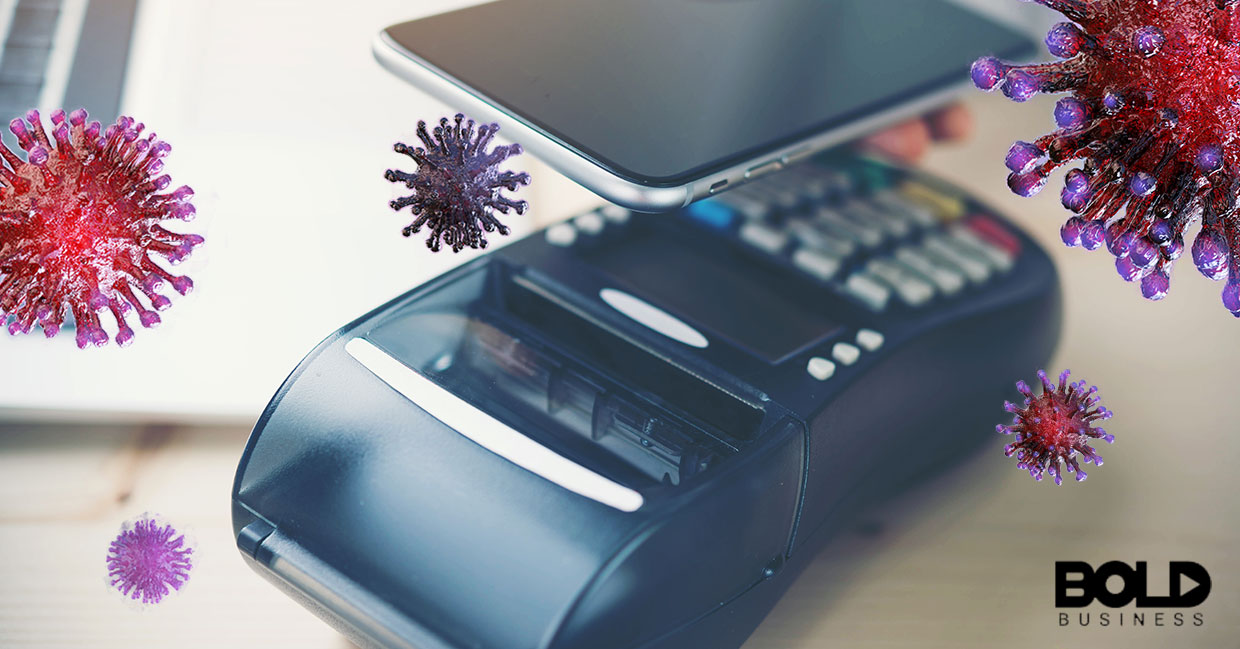
A contact-free transaction with coronavirus everywhere
The days of exchanging money or swiping credit cards might be over – thankfully, contactless cards are here.

Contactless cards offer another, and perhaps even better way, to pay using digital payments. These cards work like Apple Pay and Google Pay in that they can be tapped to complete a financial transaction. But their technology is slightly different. Contactless cards use near-field communication via a radio wave antenna. In the process, the card creates a dynamic cryptogram code that is unique for each transaction. Not only is it more secure, but it is also very convenient and fast. And perhaps for U.S. consumers, it best mimics using a credit or debit card otherwise.

“I can see consumer behaviors changing for sure from the situation we’re in. When those consumer behaviors change over several months, they tend to stick.” – Linda Kirkpatrick, President of U.S. issuers for Mastercard

American Consumers Slow to Change…Until Now

When it comes to technology, most of us assume the U.S. is ahead of the game in most areas. But when it comes to contactless cards and digital wallets, we are clearly lagging behind. In the U.S., only 3 percent of all financial transactions use contactless cards to pay. In contrast, nearly two-thirds of those in the U.K. and 96 percent in South Korea use this form of payment. Canada and Australia are also much more advanced in the use of these systems as well. Up until now, Americans have simply been unwilling to make the change and use digital payments.


This lag among American consumers isn’t due to a lack of effort by financial institutions. In fact, all the major credit card carriers, such as Visa, Mastercard and others, have been promoting contactless cards. Likewise, Apple Pay and Google Pay has done the same for their digital payments’ platform. But it appears that the coronavirus pandemic may be the key development that finally tips Americans over the edge. The fears associated with acquiring the virus via contact spread looks to be helping consumers make the shift.

“I think there will be an explosion of services and functionalities that will come out in the next few months. Necessity is the mother of invention, and there’s a whole lot of necessity right now.” – Jane Barratt, Chief Advocacy Officer at MX

More Than Just Contactless Cards to Come

With such concerns about the spread of coronavirus, contactless cards and digital payments have caught the attention of several retailers. For example, Walmart is introducing contactless pickup, delivery, as well as in-store payment options. Publix grocery stores have also implemented a tap-to-pay system in its 1,200+ stores. And even Burger King is promoting contactless drive-thru services for both payment and order pick-up. In addition to other retailers who have already embraced these payment platforms, many others are coming on board. And many analysts assume these systems will be commonplace by the end of the year.

In addition to these digital payment systems, other touchless transaction models are also gaining momentum. For example, delivery drones, which have been limited due to regulatory restrictions, may soon become another touchless option. Amazon Go stores may also expand with their Just Walk Out systems. These systems allow customers to enter the store by tapping digital payments on a turnstile. They can then collect their items and simply leave without further interactions or contacts. And companies like Starship have been advancing sidewalk robots for contactless food deliveries in some areas. All of these technological innovations are likely to receive a boost as a result of the coronavirus pandemic.

Are We at a Tipping Point for Contactless Cards?

By all accounts, it would seem that Americans are at a tipping point to convert to digital payments. But some obstacles remain. For instance, approximately 7 percent of all U.S. households do not use bank accounts. This would naturally hinder full adoption of a digital financial transaction platform. In addition, many Americans still prefer to use cash, despite the currency handling concerns. While these pose some challenges, the social impacts that COVID-19 is likely enough to accelerate the use of contactless cards. Thus, most of us can expect a major shift to touchless shopping is just around the corner.

Virgin Space Flight Is Launching Rockets from Planes

If space is the final frontier, then Virgin Orbit (VOX Space) plans to be the business leading the way. With an interesting and unique design, the company anticipates being able to conduct space missions from numerous locations. This is one of the reasons that the U.S. Space Force recently awarded VOX with a $35 million contract. The contract includes 3 Virgin space flight launches over the next few years in an effort to expand the space domain. But whether these missions prove to be successful is anyone’s guess given that Virgin Orbit is still in testing mode.

The U.S. Space Force plans to actively pursue space for a number of reasons. For one, intentions include the development of a more extensive space communications platform covering the earth. But in order to achieve that, numerous satellites will be required in addition to several rocket payloads. The goal is thus to use a Virgin space flight to facilitate these pursuits delivering materials to low earth orbits. If this proves successful, then development of this proximal space infrastructure may occur more rapidly than anticipated.

“With the space domain more contested than ever, it’s crucial that we find ways to enable those responsible for space security to act quickly and effectively. Ultimately, we believe that affordable and responsive launch helps keep everyone safer—in part by creating a major disincentive for adversaries to work against existing satellites and space systems.” – Dan Hart, CEO of Virgin Orbit

The Unique Approach of the Virgin Space Flight

Unlike many other space companies, a Virgin space flight does not attempt to create an entirely new rocket launch system. Instead, VOX uses an adapted 747 airplane as a carrier of a rocket to facilitate access to space. The 747 airplane, named Cosmic Girl, is specifically altered to carry a rocket under one wing. The rocket, named Launcher One, disengages from the plane once in flight and boosts itself into a low earth orbit. In the process, the rocket is capable of carrying satellites and other payloads into space for a variety of purposes. The U.S. Space Force is banking on VOX’s technology and design in helping them achieve their space goals quickly.

A Virgin Space Flight jet with a rocket underneath
No, that’s not a missile attached to that Virgin Space Flight jet.

In terms of the U.S. Space Force contract, Virgin Orbit is expected to conduct its first launch in October of 2021. This will be its first of 3 launches that will carry a dozen satellites each into low earth orbit. This will be in addition to other orbital payloads that the Department of Defense wishes to pursue as part of its space programs. In fact, the specific program in which the Virgin space flight will be participating is DOD’s Orbital Services Program 4. Its precise mission is to increase space domain awareness while developing low orbital space infrastructures. If VOX launches show success, it is therefore likely that many future contracts with DOD will result.

Virgin Orbit and Virgin Galactic – Two Distinct Entities

With the announcement that VOX received the U.S. Space Force contract, Virgin Galactic share prices climbed. However, Virgin Galactic and Virgin Orbit are completely unrelated. While Virgin Galactic is publicly traded, Virgin Orbit is privately held. In fact, Virgin Orbit spun off as a separately entity in 2017 and is privately owned by Sir Richard Branson. Thus, while investors may want a piece of the action of the upcoming Virgin space flight, this isn’t likely to happen. Like Elon Musk and other bold leaders in the space field, it would seem Branson wishes to keep VOX to himself for the time being.


Of course, Virgin Orbit is not without its own competitors. Three of the main ones include SpaceX, X-Bow, and Firefly Black. But what is most attractive about the Virgin space flight is its ability to potentially launch from any airport. Because it utilizes a 747, access to a low earth orbit could be pursued any nearly any location. This proximity saves on costs in numerous ways. And it is a reason why Virgin Orbit looks more appealing for this type of launch compared to its competitors. Undoubtedly, this played a role in the U.S. Space Force’s decision to go with Virgin Orbit.

“We’re leveraging no infrastructure from the base itself other than the runway and the allocated piece of tarmac where we can load the rocket and service the rocket. Rather than having to fly out of Florida and perform a big dog leg maneuver to be able to get to an equatorial orbit, we’d rather just fly the airplane to the right latitude and launch.” – Mandy Vaughn, President of VOX Space

Final Preparations Before the U.S. Space Force Launch

While VOX is excited about the U.S. Space Force contract, it’s not quite ready for the first Virgin space flight. Still in the testing phase, Virgin Orbit will next test taxiing capabilities with the 747 carrying the rocket. Subsequently, it will then conduct a demo flight and launch later in 2020 to ensure everything is operational. Assuming all goes well, VOX will then prepare for its inaugural U.S. Space Force launch in the fall of 2021. Thus, potentially, the Virgin space flight schedule could become quite busy after this date if missions show success.

Naturally, the coronavirus pandemic has set the company back like it has numerous other businesses. Based in California, Virgin Orbit had to take action relatively early to protect its staff. After a week of sterilization procedures, the company now has 90 percent of its members working from home. And others are fully equipped with personal protective equipment with CDC standards now in place. At present, the first Virgin space flight is still expected to launch as planned. Without question, many are awaiting the launch with great anticipation. Virgin Orbit may well play a key role in ushering in a new era of space exploration and development.

Got Food? Grocery Delivery Services Are Booming

With city and state lockdowns and stay-at-home orders, people have naturally stocked their cupboards and refrigerators. And since dining at local restaurants are no longer an option, take-out and cooking meals at home have become the norm. Of these two options, those who have been laid off or unemployed see home-cooking as their preference. But going to the grocery store is not only frustrating (due to empty shelves) but likewise increases COVID-19 exposure risks. It’s therefore little surprise that grocery delivery services are booming.

While grocery delivery services have been increasing in popularity for some time, the recent coronavirus pandemic has accelerated the trend. Even those who consider themselves “old fashioned” have overcome their anxieties and downloaded these apps. But some are speculating that the rise in grocery business will be short-lived. If so, what does this mean for grocery delivery services? Are they simply riding the coattails of a temporary surge in consumer demand? Or will this represent a tipping point in favor of grocery delivery services in the future? These are the questions many in the grocery business industry are asking in planning for a post-pandemic world.

“As COVID-19 has spread, we’ve seen a significant increase in people shopping online for groceries. This resulted in a systems impact affecting our ability to deliver Amazon Fresh and Whole Foods Market orders.” – Amazon spokesperson statement

Increases in Grocery Delivery Services by the Numbers

Prior to the COVID-19 pandemic, many customers were also using grocery delivery services. The convenience of placing their orders over an app saved time and allowed easy re-ordering. Likewise, customers could choose to have their items delivered to their home or be available for pick-up. Grocery retailers have been competing for some time in this area. Similarly, some independent businesses, like Instacart, have excelled in this space as well. It therefore stands to reason that our current crisis has accelerated the use of these grocery delivery services across the board.

A man risking all to deliver groceries
Lockdowns and quarantines have been a boon for grocery delivery services.

In terms of Instacart, the company has reported some pretty astounding figures. During a recently report 2-week period, their growth in demand nearly doubled. Currently, they are reporting roughly 350,000 customers nationwide, which increased from 200,000. At the same time, the number of grocery store delivery services apps that have been downloaded has also boomed. While Instacart app downloads increased over 200 percent, there was a 160 percent increase in Walmart Grocery app downloads. And Shipt app downloads, which was recently added to Target’s grocery business, expanded 124 percent. All of this highlights just how tremendous this segment of the grocery business has grown.

“In my 38 years in the customer support industry, I’ve never seen anything quite like this…COVID-19 is affecting every one of us over a sustained period of time and, as a result, we’ve had to reimagine and rescale [Instacart’s] Care operations overnight…” – Mark Killick, Vice President of Instacart Care Operations

Grocery Business Challenges in the Delivery Segment

As the grocery delivery services segment has expanded, so has some of the challenges being faced. One of these challenges has been the ability to address customer complaints and concerns. For Instacart, this has meant expanding their customer Care Team. The company has already increased its support staff from 1,200 members to 3,000. And by the end of May, they plan on having a total of 18,000 Care Team personnel. In fact, Instacart recruiters have specifically targeted unemployed retail workers for these positions. At the same time, Instacart shoppers have also been increased in number. And for those in the hospitality, travel and tourism sectors, this has been welcomed as an alternative for income.


Naturally, all grocery business operations that provide grocery delivery services are experiencing these issues. But each of them is also having to address employee concerns as well. With many grocery business employees on the frontlines of the coronavirus pandemic, health and compensation issues are being raised. This has led some to increase employee wages, reduce store hours, and offer personal protective equipment to staff. For Instacart, however, this has involved additional demands by employees such as tip guarantees and hazard pay. In response, Instacart has removed the no-tip option for customers and created contact-less pay options. These types of issues are still evolving as the pandemic persists.

“In our view, COVID-19 has parallels to both 9/11 and the [2008-2009] recession. The 9/11 period led to ‘nesting’ [and] ’08/’09 led to demand destruction. COVID-19 will lead to both.” – Karen Short, Barclay’s Analyst

The Potential for Boom to Bust

While the good times are rolling for the grocery business right now, this may not be the case for long. Analysts suggest that the coronavirus pandemic will exhibit features common to the 9/11 crisis and the Great Recession. In fact, this is already evident with consumers nesting toilet paper and other items. Likewise, global economic impacts are continuing to show declines in the markets. Based on this, the boom for the grocery business may soon turn to bust. Consumers will likely soon turn to goods with lower profit margins to save money and lower their demand. This will cause price deflation of grocery items in addition to reduced profits.

The picture regarding grocery delivery services is less clear, however. As consumers become more accustomed to using apps and receiving groceries at home, buying habits may change. This could perpetuate the current trends in grocery delivery services. At the same time, as restrictions are eased, and restaurants re-open, the demand for such services may decline. In all likelihood, the end result may be somewhere in the middle for grocery delivery services. In other words, the current boom won’t last, but the industry may still enjoy long-term gains. Most involved in grocery delivery services seem to believe this to be the case based on their current investments.

How can we help?

Bold Business Insights
Privacy Overview

This website uses cookies so that we can provide you with the best user experience possible. Cookie information is stored in your browser and performs functions such as recognising you when you return to our website and helping our team to understand which sections of the website you find most interesting and useful.