
Bold Business Logo

Higher Education and Economic And Social Mobility – Part II

Studies have shown that people who go on to higher education, go on to earn higher salaries and increase their own mobility upward, economically and socially. But, the bold question here is whether the U.S education system can provide those without a privileged background with the knowledge and opportunity they need to access the best that higher education has to offer or not. Indeed, a top education is viewed as the key to economic and social mobility. And a college degree has helped so many achieve the American dream. However, as a failing education system ‘dumbs down’ Americans and students fight for fewer college places with increased fees, accommodation and living expenses, the best education is once again only being afforded to the elite.

Education in the United States

According to studentfirst.org, about 22 percent of eighth-graders scored below the basic level on the 2013 NAEP reading test, and only about 36 percent were at or above grade level. Likewise, according to Pew Research, the 2015 results from the Programme for International Student Assessment (PISA), revealed that the U.S. came 38th in math and 24th in science—out of 71 countries.  Experts say the problem lies with the K-12 education system, which often fails to prepare students for college education and a healthy future. Parents from the middle and upper classes can combat the inadequacies supplied by the American education system by providing their children with after-school tutors and advanced reading materials or sending them to private schools. It goes without saying that these are advantages which financially-challenged students and their families cannot afford.
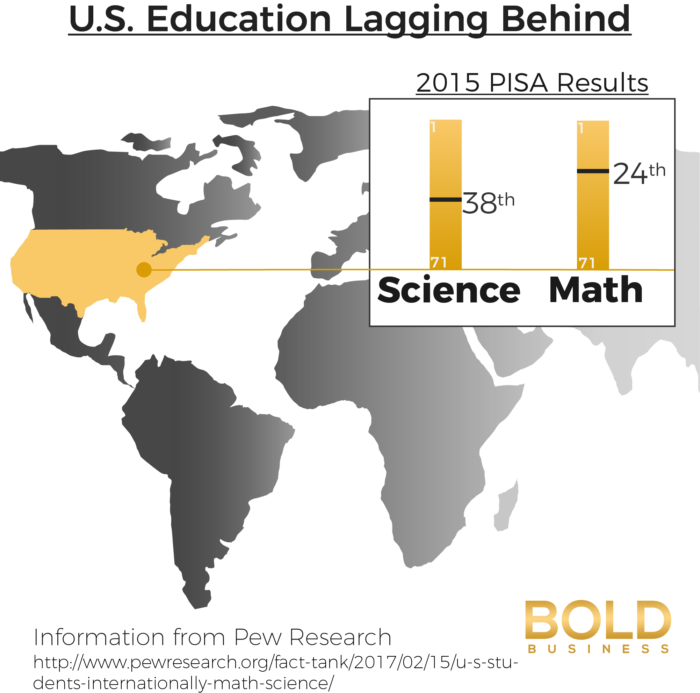
an infographic with data in relation to higher education and the fact that the U.S. Education System is lagging behind

Even if “poorer” students make it through the many obstacles to college education, there are still further hurdles to overcome. According to Brookings, a college degree can be worth much less if you are brought up unwealthy because the student with the same degree from a more privileged background will have better access to resources that will help propel them to a better standing. In fact, results show that college graduates from families with an “income below 185 percent of the federal poverty level earn 91 percent more than high school graduates over their career”. On the other hand, college graduates from families with “incomes above 185 percent of the FPL earned 162 percent more over their careers than those with a high school diploma”.

Higher Education In Relation To Economic and Social Mobility

In the United Kingdom, the education system is structured slightly differently but still suffers many of the same issues the American system is now facing. According to The Guardian newspaper, education reform has failed to improve social mobility. It is widely believed that in Britain today economic and social mobility is in decline, as it is in the United States. The newspaper states that “more individuals are now experiencing social descent and fewer social ascent simply because the numbers ‘at risk’ of the former have increased”.

Veritably, young people entering the labor market face far less favorable mobility prospects than their parents did at the same age. In conclusion, it does still take a top education to enable success today, but it is being afforded to fewer young people from less privileged backgrounds.

In America, CollegeNET has developed a new data-driven ranking of higher education quality—the Social Mobility Index (SMI)—to help raise education standards. The SMI “measures the extent to which a college or university educates more economically disadvantaged students at lower tuition, so they can graduate and obtain good-paying jobs”. The index will hopefully help improve education standards across the United States.

Availability of Quality Education For All

Senator Bernie Sanders once said that “the reality is that the middle class today in this country is in desperate shape, and the gap between the very very wealthy and everyone else is going to grow wider”. Experts say it is fundamentally important to ensure that we encourage economic and social mobility through the power of education—including higher education —to close the gap between the top and bottom 1 percent. Without economic and social mobility, American society will become even more unequal still—with the less privileged having an even smaller chance of achieving success and climbing the ladder.

Undoubtedly, it will take bold actions by politicians, educators and activists to ensure that access to a top education is available to all backgrounds to enable economic and social mobility in the United States.

Nature Or Nurture? A Question in Economic And Social Mobility – Part I

There has always been debate surrounding whether education, a family’s social standing, parental income, and other factors can affect the chances of success and higher social and economic mobility later in life. Studies have shown that individuals provided with a better opportunity structure go on to earn higher salaries and increase their upward social mobility. It, therefore, raises the bold question of whether America’s elite are born or made. In other words, we have reached the point of assessing if the matter on economic and social mobility is about nature or nurture.

The Economist newspaper recently dissected a report where a team of experts from the Department of Education looked at 30 million tax returns to determine how earnings vary per parental income. Economists found that family background is the most important factor in economic and social mobility in the United States. Results in this particular report showed that those brought up with a “household income in the lowest fifth has a one-in-ten chance of reaching the top fifth of earnings themselves. This is just half what would be seen if parents did not pass any earnings advantage on to their children.” However, the report also found that students from low-income families are still able to reach the upper-middle classes if they attend an elite university. For example, a graduate from one of the Ivy League institutions has roughly a “two-thirds chance of making it into the top 20 percent”. However, it is extremely difficult to get into one of the elite universities. And breaking into the top 1 percent is almost impossible. For the few, they can squeeze in through pure hard work and determination. On the other hand, others with a more privileged background breeze in without issue—sometimes because of relatives that happen to be Ivy alumni.

an infographic containing data about socioeconomic mobility amid the question revolving around nature or nurture of the matter


On Economic and Social Mobility

A study by Pews found that the correlation between parents’ income and their children’s income is undeniable. Results show that “43 percent of children born into the bottom quintile remain in the bottom as adults” and “40 percent of children raised in the top will remain there as adults”. Alternatively, only “4 percent of those raised in the bottom moved up to the top quintile as adults”. Therefore, results prove that opportunity structures provided by families do determine a future generation’s success. It seems that the matter of nature or nurture is becoming more clearer.

Economic and social mobility is fundamentally important to building a better society and can be determined by many different factors, including family wealth, race, sexuality, color, location, religion, genetics, culture, education and connections. Although the likes of Bill Clinton and Benjamin Franklin made their way from working-class backgrounds to the White House, it is usually the elite who stick together in their social circles to produce future presidents, banking billionaires and leading public figures.

In relation to the discussion of nature or nurture: Even though economic positioning has been determined as one of the most important factors in leveraging your way to the elite division, education is equally as important.

On the Matter of Nature or Nurture

It has been proven time and time again that college graduates can indeed climb the corporate ladder, more so than those without a top education. Education has been a key to socioeconomic mobility in America since the great income inequality during the industrial revolution. And this viewpoint has not waivered.

Americans are brought up to believe that a college degree provides access to better opportunities and a better life. And this case has been especially true to those from poorer backgrounds. However, with more and more students aiming for a college degree and fewer jobs on the market, is a college education alone enough to fulfill the American dream? Economists, experts and educators have debated this very subject over recent years. It goes without saying that they have reached varying conclusions. Therefore, Bold Business dives deeper first into whether education, including higher education, is the key determinant to economic and social mobility in the United States. Check out the article “Higher Education and Economic And Social Mobility – Part II” here.

How can we help?

Bold Business Insights
Privacy Overview

This website uses cookies so that we can provide you with the best user experience possible. Cookie information is stored in your browser and performs functions such as recognising you when you return to our website and helping our team to understand which sections of the website you find most interesting and useful.